

 Telegram
How to Play Razz Poker – Rules

Razz is a unique form of poker that flips traditional hand rankings upside down. Instead of aiming for the highest hand, players compete to make the lowest possible five-card hand using the Ace-to-Five (A-5) lowball system. Based on the structure of Seven Card Stud, Razz is played with seven cards dealt to each player, but only the best five-card low hand counts at showdown. There are no flushes or straights, and aces are always low, making the best possible hand A-2-3-4-5, often called “the wheel.”
The game includes multiple betting rounds, beginning with a bring-in bet from the player showing the highest upcard. As more cards are revealed, players must carefully evaluate visible cards, opponents’ boards, and the strength of their own developing low hand. Understanding hand selection, board reading, and betting strategy is essential to succeeding in Razz poker.
- What Is Razz Poker?
- How To Play Razz Poker Step By Step
- Razz Poker Low Hand Rules (A-to-5 Lowball)
- Open Cards, Hidden Cards, and Dead Cards in Razz Poker
- Betting Order in Razz Poker: Highest vs Lowest Exposed Hand
- Razz Poker Betting Structure
- Razz Poker vs Seven Card Stud: Key Differences
- How To Play Razz Poker Online
- Razz Poker FAQs
What Is Razz Poker?
Razz is a lowball poker variation where the goal is to make the lowest possible five-card hand rather than the highest. It is part of the Seven Card Stud family and is commonly played in mixed poker formats such as HORSE. Each player receives seven cards throughout the hand, but only the best five cards are used to determine the winner.
Razz uses the Ace-to-Five (A-5) lowball ranking system, which means aces are always low, and straights and flushes do not count against a hand. The best possible hand is A-2-3-4-5, also known as the wheel.
Unlike many poker games, Razz begins with a bring-in bet from the player showing the highest upcard, creating a different strategic dynamic from the start.
How To Play Razz Poker Step By Step

Razz uses a structured card-dealing and betting sequence similar to Seven Card Stud, but the goal is completely different. Instead of trying to make the strongest high hand, players try to make the lowest five-card hand, using a ranking system from Ace to Five. Each player receives seven cards during the deal, some face down and some face up, with bets placed after certain cards are dealt. The game includes an ante, a bring-in, and several betting rounds, where players evaluate both their own cards and the visible cards of their opponents. Understanding how each street works is essential for making correct decisions and recognizing when a low hand is likely to improve.
Antes and initial deal (two down, one up)
A Razz hand begins with antes, which are small forced bets placed by every player at the table before any cards are dealt. Antes create action in the pot and ensure that players compete for chips right from the start. After the antes are posted, each player receives their first three cards, known as Third Street: two face-down cards (hole cards) and one card face up (the door card).
Unlike most poker games, the player showing the highest door card must make the bring-in bet, a small forced wager that starts the first round of betting. If two players show the same high card, suit ranking may determine who brings it in. After the bring-in, betting continues clockwise, with players choosing to call, complete the bet, raise, or fold.
Betting rounds from Third Street to Sixth Street
After the bring-in and initial betting on Third Street, the dealer gives each remaining player another face-up card, beginning the next stage called Fourth Street. From this point onward, the player showing the lowest visible hand starts the betting round, which is a key strategic difference from many other poker games.
Betting continues clockwise, and players can check, bet, call, raise, or fold depending on the table stakes. The same process repeats on Fifth Street and Sixth Street, with one additional face-up card dealt during each round followed by betting.
As more cards appear on the table, players must carefully track their own potential low hand, the cards already visible, and the likelihood that opponents are drawing to stronger low combinations.
Seventh Street and final betting round
Once the betting round on Sixth Street is complete, each remaining player receives a final card known as Seventh Street or the river. Unlike the previous streets, this card is dealt face down, meaning it is hidden from opponents. At this stage, every player has a total of seven cards: three face-down cards and four face-up cards.
After Seventh Street is dealt, the final betting round begins. As with the previous streets, the player with the lowest visible board starts the action. Players must decide whether their completed hand is strong enough to bet, call, or raise, or whether folding is the better option.
Because the last card is hidden, players must combine board reading, probability, and betting patterns to estimate the strength of their opponents’ potential low hands.
Showdown and determining the best low hand
If two or more players remain after the final betting round, the hand proceeds to a showdown. Players reveal their cards and construct the best possible five-card low hand from the seven cards they were dealt. Razz uses the Ace-to-Five lowball system, meaning aces count as low cards and straights and flushes are ignored when evaluating hand strength.
The goal is to make the lowest possible five-card hand. Unpaired hands are strongest, because pairs count against you. The best possible hand is A-2-3-4-5. Hands are read from the highest card downward, so a 7-low beats an 8-low.
If two players have identical five-card lows, the pot is split evenly between them. Understanding how to read and compare low hands is essential for success in Razz.
Razz Poker Low Hand Rules (A-to-5 Lowball)
The Razz poker game uses the Ace-to-Five (A-5) lowball hand ranking system, which means the goal is to make the lowest possible five-card hand. Unlike traditional poker, the strength of a hand is determined by its highest card, so hands with lower top cards are stronger. Aces always count as low cards, and players must form the best five-card combination from the seven cards they receive during the hand.
Key rules for evaluating a Razz hand include:
- Aces are always low, making an ace the strongest individual starting card in Razz.
- The lowest possible hand is A-2-3-4-5, also called the wheel.
- Straights do not count against a hand, so A-2-3-4-5 is still the best hand even though it forms a straight.
- Flushes do not count against a hand, meaning suits have no impact on hand strength.
- Pairs weaken a hand, since duplicate ranks reduce the number of low cards available.
Why straights and flushes do not count in Razz
Straights and flushes are ignored in Razz because the game follows the Ace-to-Five lowball system, which focuses purely on the numerical value of the cards rather than traditional poker hand patterns. In standard poker, combinations like straights and flushes make hands stronger, but in Razz the objective is simply to assemble the lowest ranks possible without worrying about suits or sequential order.
This rule simplifies hand evaluation and keeps the focus on card rank rather than hand structure. For example, a hand such as A-2-3-4-5 is still considered the best possible hand even though it forms a straight. Similarly, five cards of the same suit do not count as a flush penalty. Because of this, the only real problem for a Razz hand is pairs, which raise the effective value of the hand.
Open Cards, Hidden Cards, and Dead Cards in Razz Poker
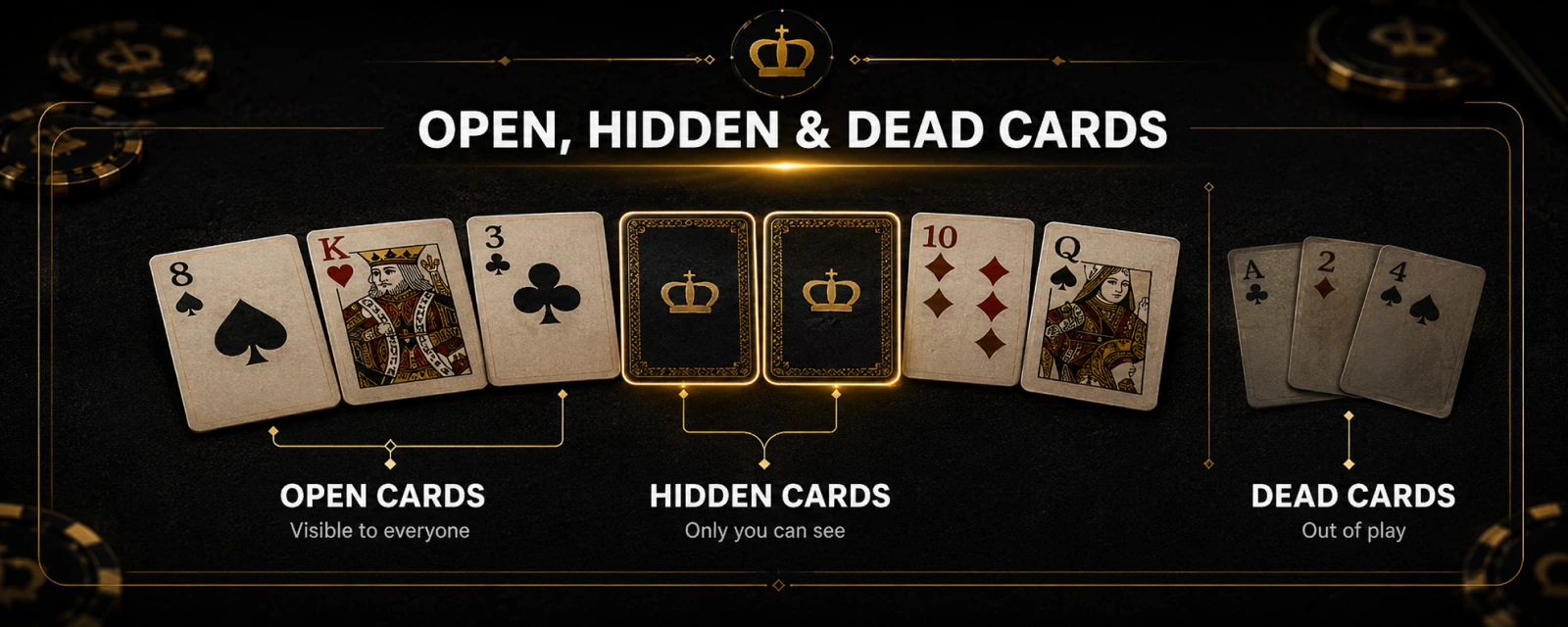
In Razz poker, understanding which cards are visible and which are hidden is a crucial part of Razz strategy. Because several cards are dealt face up during the hand, players can gather valuable information about their opponents’ potential low hands. By carefully observing the table, you can estimate the likelihood of completing your draw and determine whether certain cards are still available in the deck. This awareness is often called board reading, and it plays a major role in decision-making throughout the betting rounds.
Here are the three key types of cards in Razz:
- Open Cards (Upcards) – These cards are dealt face up and are visible to everyone at the table. Players receive multiple upcards from Fourth Street to Sixth Street, allowing opponents to track possible hand development.
- Hidden Cards (Hole Cards) – These cards are dealt face down and are only visible to the player holding them. In Razz, players receive two cards on Third Street and one more on Seventh Street.
- Dead Cards – Dead cards are cards that have already been folded or are visible on other players’ boards, making them unavailable to complete your low hand. Tracking dead cards helps you understand how likely it is to improve your hand.
Betting Order in Razz Poker: Highest vs Lowest Exposed Hand
Betting order in Razz differs from many other poker games because it changes depending on the stage of the hand. Since Razz is a lowball game, the betting action is often determined by the value of the exposed cards (the face-up cards on the table). This creates a unique dynamic where players with stronger visible low hands often control the betting as the hand progresses. Understanding who acts first during each street is essential for reading the table, applying pressure, and protecting a developing low hand.
The betting order follows these key rules:
- Third Street (Initial round) – The player showing the highest upcard must post the bring-in bet and begins the betting round.
- Fourth Street – The player with the lowest visible hand starts the action.
- Fifth Street – The player showing the best (lowest) board acts first.
- Sixth Street – Betting again begins with the lowest exposed hand.
- Seventh Street – The player with the best visible low hand initiates the final betting round.
Because upcards are exposed in Razz, players can constantly evaluate who likely holds the strongest low hand and adjust their strategy accordingly.
Razz Poker Betting Structure
Razz poker uses a fixed-limit betting format, meaning the bet and raise amounts are predetermined. Unlike no-limit poker, players cannot bet any amount they choose. Instead, betting limits increase at certain stages of the hand. This structured betting system maintains balance in the game and places greater emphasis on hand reading, card tracking, and strategic decision-making, rather than large bluff bets.
Since Razz is based on seven-card stud, bets are placed after specific cards are dealt. The game also includes forced bets, such as antes and bring-ins, which help generate action in the pot before the main betting rounds begin.
Fixed-limit betting rules
Most Razz games follow a fixed-limit structure, where the bet size is set according to the stakes of the table. For example, in a $10/$20 Razz game, smaller bets are used during the early streets, while larger bets are used in later rounds.
Key fixed-limit betting Razz poker rules include:
- Third Street and Fourth Street use the lower betting limit (small bets).
- Fifth Street, Sixth Street, and Seventh Street use the higher betting limit (big bets).
- Players may bet, call, or raise, but the size of each action is fixed by the table limits.
- The number of raises per betting round is usually capped (commonly three or four raises).
- Fixed limits reduce the risk of massive pots forming in a single hand.
Bring-in and forced bets in Razz Poker
Before regular betting begins in Razz, the game includes forced bets that help build the pot and initiate action. These mandatory wagers occur at the start of every hand.
Important forced bets in Razz include:
- Antes – Every player at the table posts a small ante before the cards are dealt. This ensures there is already money in the pot.
- Bring-in bet – After the initial three cards are dealt, the player showing the highest upcard must post the bring-in.
- Completing the bring-in – The player posting the bring-in may complete to the full small bet amount, and the remaining players may call, raise, or fold.
- Action continues clockwise around the table after the bring-in is posted.
Razz Poker vs Seven Card Stud: Key Differences
Razz Poker and Seven Card Stud share the same basic structure: players receive seven cards, betting occurs across multiple streets, and several cards are dealt face up. However, the main difference lies in how hands are evaluated. While Seven Card Stud rewards the highest traditional poker hand, Razz is a lowball game, meaning the player with the lowest five-card hand wins the pot.
Another important difference is the betting order. In Razz, the highest exposed card starts the action on Third Street, while later rounds are led by the player showing the lowest exposed hand. Because of these rule changes, Razz poker strategy focuses heavily on tracking exposed cards and building the lowest possible combination.
| Feature | Razz Poker | Seven Card Stud Poker |
|---|---|---|
| Objective | Make the lowest five-card hand | Make the highest five-card hand |
| Hand Ranking | Ace-to-Five lowball system | Standard poker hand rankings |
| Best Possible Hand | A-2-3-4-5 (the wheel) | Royal Flush |
| Straights and Flushes | Do not count against the hand | Count as strong hands |
| Third Street Action | Highest upcard posts the bring-in | Seven Card Stud uses the lowest exposed card for the bring-in |
| Later Betting Rounds | Lowest visible hand acts first | Highest visible hand acts first |
| Strategy Focus | Low cards and avoiding pairs | Building strong high-card combinations |
How To Play Razz Poker Online
Playing Razz poker online is straightforward once you understand the basic rules and how online poker platforms manage the game automatically. Most poker sites handle the dealing, betting order, and pot calculations for you, allowing players to focus on strategy and decision-making. Razz is commonly available in mixed poker formats such as HORSE, but some platforms also offer standalone Razz tables.
Follow these basic steps to start playing Razz poker online:
Choose a poker platform that offers Razz or mixed games like HORSE.
Create an account and deposit funds if you want to play for real money.
Select a Razz table that matches your preferred stakes and betting limits.
Join the table and post the ante when the hand begins.
Receive your cards automatically, including two down cards and one upcard on Third Street.
Follow the betting prompts as the game progresses through each street.
Build the lowest five-card hand possible to win the pot at showdown.
Razz Poker FAQs
How are hands ranked in Razz Poker?
Razz uses the Ace-to-Five lowball ranking system, so the best Razz poker hand is the lowest possible five-card hand. Aces count as low cards, and flushes and straights are ignored. Hands are evaluated by their highest card first, meaning a 7-low beats an 8-low, and pairs weaken a hand.
What is the best possible hand in Razz Poker?
The best possible hand in Razz is A-2-3-4-5, often called the wheel. Because aces are low and straights do not count against a hand, this combination forms the lowest possible five-card hand, making it unbeatable in standard Razz hand rankings.
Why do straights and flushes not count in Razz?
Razz follows the Ace-to-Five lowball system, which evaluates hands purely by card rank rather than patterns like straights or flushes. Ignoring these combinations keeps the focus on building the lowest possible cards and simplifies hand comparisons between players.
Why are pairs bad in Razz Poker?
Pairs are bad in Razz because the goal is to create five different low cards. When a pair appears, it reduces the number of unique low ranks in your hand and forces a higher fifth card to complete your five-card combination.
Are there split pots in Razz Poker?
Yes, Razz can result in split pots when two or more players have identical five-card low hands at showdown. In that case, the pot is divided evenly between the tied players since suits do not break ties in Ace-to-Five lowball rankings.
Can I play Razz Poker safely online?
Yes, you can play Razz safely online by choosing licensed and reputable poker platforms. Look for sites that use secure encryption, fair random number generators, and responsible gaming policies to ensure games are transparent and player funds remain protected.
Thanks for your feedback!