

 Telegram
How to Play Omaha Hi-Lo Poker – Rules

If you want to learn how to play an Omaha Hi-Lo game, this guide covers the core poker rules, betting flow, and hand structure you need to know. Also known as Omaha 8, this split-pot format rewards players who can read both the high and low sides of the board. You’ll see how a hand is dealt, how betting works, and what makes Omaha Hi-Lo different from Omaha High.
- What Is Omaha Hi-Lo Poker?
- How To Play Omaha Hi-Lo
- Omaha Hi-Lo Hand Rules: High and Low Hands
- Omaha Hi-Lo Betting Rules
- Betting Formats in Omaha Hi-Lo
- Omaha Hi-Lo Starting Hand Requirements
- Omaha Hi-Lo Vs Omaha High: Key Differences
- How To Play Omaha Hi-Lo Poker Online
- Omaha Hi-Lo Advanced Rules FAQs
What Is Omaha Hi-Lo Poker?
Omaha Hi-Lo, also known as Omaha 8 or Omaha Eight-or-Better, is a poker variant where the pot can be split between the best high hand and the best low hand. The object of Omaha Hi-Lo is not just to make one strong poker hand, but to compete for both halves of the pot whenever possible. In this split-pot game, that creates more strategic pressure than in regular Omaha.
Each player receives four private cards and must build a five-card hand using exactly two hole cards and three board cards. A low hand must be a qualifying low hand, meaning five unpaired cards ranked eight or lower, with the ace counting as low. If no low qualifies, the high hand wins the whole pot. That structure makes Omaha Hi-Lo hands much more dynamic because one holding can chase both the high and the low at the same time.
How To Play Omaha Hi-Lo

To learn how to play Omaha Hi-Lo, it helps to follow the hand in order from the blinds to the showdown. Each player starts with four hole cards, and every round of betting follows the same basic rhythm as other flop games. The difference is that players use the board and their private cards to chase both the high and low sides of the pot across all five community cards. Below is a step-by-step look at how to play the game, from the opening blinds to the final showdown.
Blinds and dealing hole cards
A hand begins with the two forced bets: the small blind and the big blind. The dealer button marks position, and the cards are dealt clockwise, starting with the player left of the button. Each active player receives four hole cards, and these are the only private cards they will use for the rest of the hand.
From a rules perspective, the setup is simple, but position matters immediately. The player to the left of the dealer posts the small blind, and the next player posts the big blind. Whether the hand is played in a live poker room or online, the structure is the same. Before any board cards appear, players must already start thinking about whether their four-card holding can compete for high, low, or ideally both halves of the pot.
Preflop betting round
The preflop action begins left of the big blind, so the first decision comes from the next active player in line. In this round of betting, players can fold, call, or raise, and the action continues clockwise until everyone has either matched the current wager or folded. These are part of the basic rules, but the strategic pressure is higher than in many other games because four-card combinations create more possible draws.
At this point, players are evaluating structure rather than made hands. A strong start usually includes coordinated low cards, suitedness, or connected cards that can develop into a strong high hand. Since the betting opens before any board is shown, discipline matters. Loose calls with one-way holdings often become expensive in Omaha Hi-Lo because a hand that looks playable preflop may later be drawing to only half the pot.
The flop and betting round
After the preflop action ends, the dealer places the flop on the board. These are the first three community cards, and they immediately change the value of every hand. In Omaha Hi-Lo, players use their hole cards with the community cards to make a final combination, but they still must respect the exact Omaha structure. You never just “play the board.”
On the flop, each player begins to see whether they can make a five-card combination for high, low, or both. A player might already have a strong draw to a five-card hand, or even a made low if the board runs low enough. This is also the point where many players misread the game because it is not enough to identify a draw in general terms. You must know how your cards work together to make a poker hand that can remain strong by the river.
The turn and betting round
The turn adds one more community card, bringing the board to four cards total. Another round of betting follows, and this is often where Omaha Hi-Lo hands become much clearer. Some draws improve, some low possibilities become stronger, and some one-way hands lose value when they are up against ranges that can win both halves of the pot.
In a limit game, the turn is also important because the bet size increases, which makes mistakes more expensive. Players should now be asking more precise questions: Is the low likely to qualify? Is the high still strong enough to continue? Can this hand still win more than half the pot? Turn decisions often separate solid Omaha Hi-Lo players from reckless ones because calling with a weak draw here can lead to river spots where the pot looks tempting, but the actual equity is poor.
The river and final betting round
The river brings the last of the five community cards, so every player can now determine the best possible result of their hand. This is the final round of betting, and it is the point where players must stop thinking in terms of draws and focus on showdown value. In Omaha Hi-Lo, that means understanding whether you hold a strong low, a strong high, or the best possible hand for one side of the pot.
Because the board is complete, every player can now build a final 5 card hand for high and, when available, a separate low using the same board. Some hands make a strong low but a weak high; others make a powerful five-card high hand but cannot claim the low at all. The river is where disciplined value betting matters most because betting a second-best hand into a split-pot game can cost far more than it first appears.
Showdown, scooping, and split pots
At showdown, the remaining players reveal their cards and the dealer determines who is winning the high and who is winning the low. If a low does not qualify, the high hand wins the entire pot. If a qualifying low exists, the pot is divided into two halves: one for high and one for low. A player who can win the low half and the high half with the same holding or with different qualifying combinations can win both the high and low sides for a scoop.
This is why scooping is so valuable in Omaha Hi-Lo. If one player wins both sides, that player scoops the entire pot. In other cases, players may split the low or divide the high, depending on the board and the exact hand values. Understanding the showdown is not just about reading the board correctly. It is about knowing whether your hand is only chasing the low half of the pot, or has a real chance to win low and contend for high as well.
Omaha Hi-Lo Hand Rules: High and Low Hands
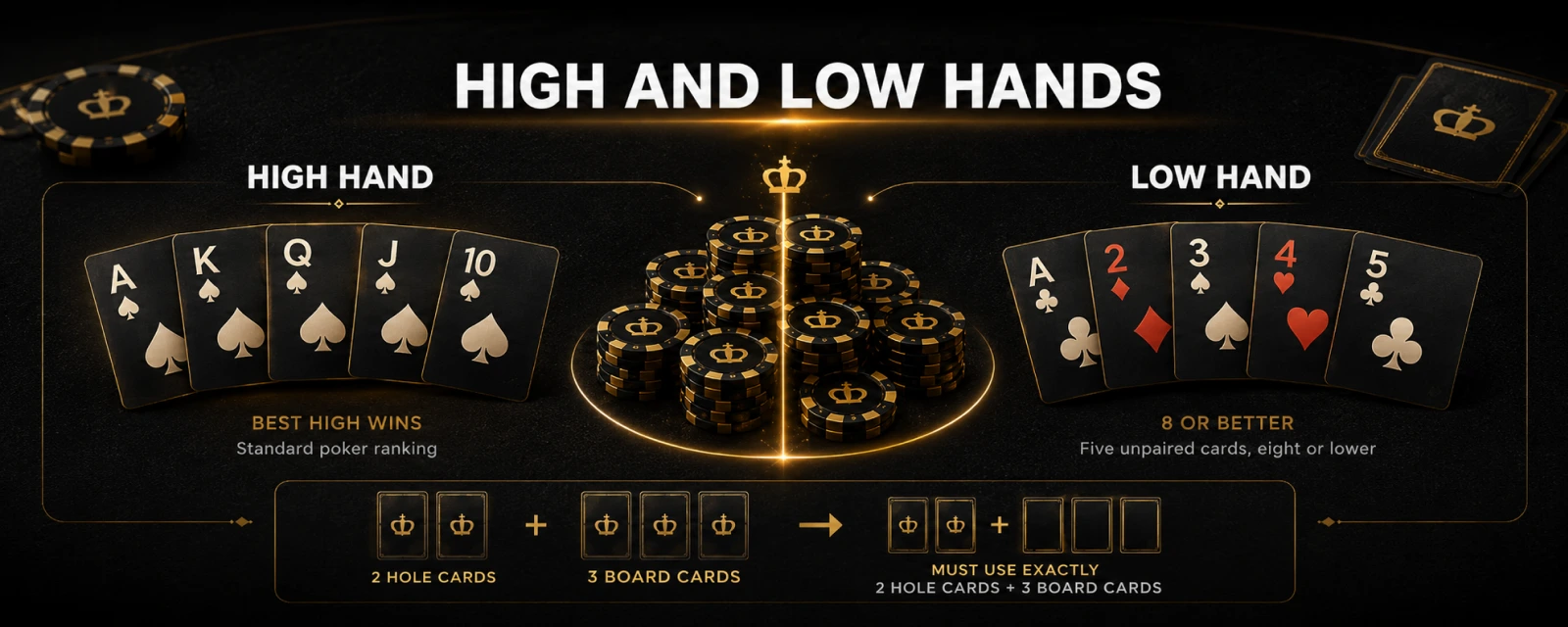
Understanding hand evaluation is the core of strong Omaha Hi-Lo decision-making. Unlike regular Omaha, this format requires players to track two possible outcomes at once: the best high hand and a qualifying low hand. That means hand ranking is only part of the picture. You also need to know when a low can qualify, how the two halves of the pot are awarded, and why some hands that look strong are actually vulnerable in split-pot situations.
Low Hand Rules: 8 or Better Explained
In Omaha Hi-Lo, the low side follows an 8 or better system. A low must be a qualifying low hand, which means five unpaired cards ranked eight or lower. The ace always plays as the lowest low card, so the best possible low hand is A-2-3-4-5. In low hand ranking, straights and flushes do not count against you, which often confuses players coming from high-only games. Even so, you still must build the hand under Omaha rules by using exactly two hole cards and three board cards.
Key low-hand rules:
- A low hand must qualify with five different cards ranked 8 or lower.
- The best low hand is A-2-3-4-5.
- Straights and flushes do not hurt a low.
- Pairs prevent a low from qualifying.
- You must still make a legal Omaha five-card hand.
High Hand Rules in Omaha Hi-Lo
The high side of Omaha Hi-Lo uses standard poker hand rankings, from high card up to a straight flush, depending on the board and hole cards. However, the critical Omaha rule never changes: players must make a five-card hand by using exactly two private cards and three board cards. That rule applies even when the board looks powerful on its own. A player may think they have a strong high hand, but if the hand is built incorrectly, it does not count.
Key high-hand rules:
- High hands follow normal poker ranking.
- A flush, full house, or straight can win the high side.
- Players must use exactly two hole cards.
- The board alone cannot make a legal Omaha high hand.
- The high hand in Omaha Hi-Lo may win the whole pot if no low qualifies.
Counterfeiting and low hand domination
Counterfeiting happens when a board card duplicates one of your important low cards and weakens your position relative to other players. For example, a hand that starts with A-2 can look strong for winning the low, but if the board pairs one of those ranks, another player may now share your low structure or beat it with better backup. This is why low hand domination matters. A hand with A-2-3 is often far safer than a low hand without support because it has more ways to stay live when the board changes.
In practice, domination is especially dangerous when you are only drawing to the low side. If an opponent can make the same low and also freeroll for high, your hand may be chasing only part of the pot while facing pressure from a better overall structure.
When the pot is split or scooped
In Omaha Hi-Lo, the pot is usually divided into two halves: one for the high and one for the low. If there is a qualifying low, one player may take the high while another player wins the low half. If no low qualifies, the high hand takes everything. A scoop happens when one player wins both sides of the pot, which is the ideal result in this format.
This distinction is strategically important. Many hands are good enough for the low half of the pot, but not strong enough to scoop. A player who is only winning the high or only winning the low may still earn less than expected if the pot is split. By contrast, a player who can win both the high and low with the best possible combination puts maximum pressure on the table and captures the full value of the hand.
Omaha Hi-Lo Betting Rules
The betting structure in Omaha Hi-Lo follows the same core flow as other community-card poker games, but the split-pot format changes how players should value aggression. Preflop action begins with the first active player left of the big blind. After the flop, turn, and river, each new round of betting starts with the first active player left of the button. In every case, action moves clockwise, and each player must decide whether to fold, call, raise, or check when no bet has been made. These Omaha Hi-Lo rules are simple on the surface, but betting well means understanding whether your hand is drawing to high, low, or both.
Key betting rules:
- Action starts with the player to the left of the big blind before the flop.
- Postflop action starts with the first active player left of the button.
- Players can fold, call, raise, or check when allowed.
- Every round ends when all active players have matched the bet.
- Bet sizing depends on the format, such as Pot-Limit Omaha or a fixed-limit game.
Betting Formats in Omaha Hi-Lo
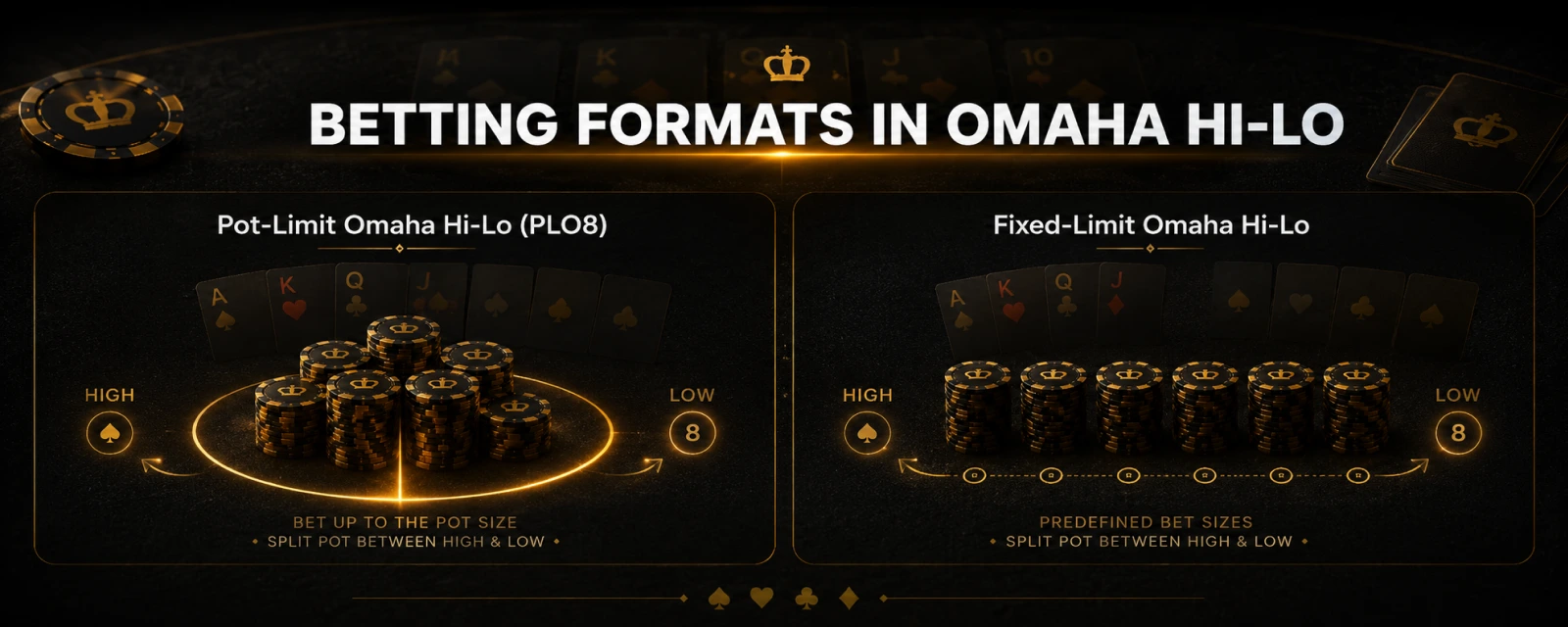
Omaha Hi-Lo can be played in more than one betting structure, and those formats change how much pressure players can apply with the same hand. Among the main versions of Omaha, the two most common are Pot-Limit and Fixed-Limit. Unlike regular Omaha or standard Omaha, where players may focus only on the high side, betting in Hi-Lo must account for split-pot equity and the possibility of winning both halves.
Pot-Limit Omaha Hi-Lo (PLO8)
In Pot-Limit Omaha Hi-Lo, often called PLO8, players may bet or raise up to the current size of the pot. That creates bigger swings and gives strong two-way hands much more leverage than they have in smaller fixed structures. Among modern Omaha Hi-Lo poker games, this is one of the most action-heavy formats because players can build large pots when they have draws to both the high and low.
The format rewards hands that can continue aggressively on multiple streets. A player with nut-low potential and redraws to a strong high can often apply pressure in ways that are not possible in a capped structure. At the same time, mistakes become more expensive. Calling large bets with a one-way hand is dangerous in PLO8, especially when that hand is only drawing to half the pot and cannot realistically scoop by the river.
Fixed-Limit Omaha Hi-Lo
In a fixed-limit format, Omaha Hi-Lo is played as a limit game, meaning the bet sizes are predetermined for each street. Preflop and flop betting use the smaller limit, while turn and river betting use the larger limit. This structure is common in a live poker room setting and is also used in mixed-game rotations, where control and discipline matter more than maximum pressure.
Because raises are capped by the structure, Fixed-Limit Omaha Hi-Lo usually produces more multiway pots and closer showdown decisions. Players still need strong fundamentals, but the format is more forgiving than Pot-Limit when someone continues with a weak one-way draw. Even so, the strategic goal stays the same: avoid investing too much when you are only chasing half, and favor hands that can win high, low, or both.
Omaha Hi-Lo Starting Hand Requirements
Starting hand selection is one of the biggest differences between Omaha Hi-Lo and high-only formats. In this game, strong starters are not just attractive-looking four cards. They are hands that work together and give you multiple paths to build the best possible hand by the river. The best hands in Omaha Hi-Lo usually have coordinated low potential, strong high potential, or ideally both, which is why structure matters more than raw card strength.
The importance of hands that can win both high and low
The strongest starting hands in Omaha Hi-Lo are the ones that can compete for both sides of the pot. A hand that can make the best high hand and the best low hand has far more value than a one-way holding because it gives you a chance to win both the high and low instead of settling for half. This is why A-2 combinations, especially with suited or connected side cards, are so important. They can develop into a strong low while still supporting a high draw.
In practical terms, you want hands that stay flexible across many boards. A starter that can chase a nut low and improve into a flush, straight, or full house puts much more pressure on opponents. In Omaha Hi-Lo, the goal is not just to survive to showdown. It is to begin with a structure that can attack both halves of the pot.
Common structurally weak starting hands
Weak starters in Omaha Hi-Lo are usually hands that look playable in a vacuum but do not work well together. A hand may contain strong high-card value, such as big cards or a pair, but still perform poorly if it has no realistic low potential. The same is true for a low-heavy holding that can make only a weak low and almost never improve into a strong high. These hands often leave a player chasing one side of the pot with very little backup.
Another common problem is disconnected structure. Four attractive cards do not automatically create a good Omaha hand if they fail to support each other. A hand with a weak high hand profile, poor coordination, or a vulnerable low draw can become expensive very quickly. In this format, hands win because of structure, not because one part of the holding looks good on its own.
Omaha Hi-Lo Vs Omaha High: Key Differences
Omaha Hi-Lo and Omaha High follow the same dealing and betting structure, but the objective is very different. In standard Omaha, also called Omaha Hi, players chase only the high hand. In Omaha Hi-Lo, they may compete for both the high and low sides of the pot, which changes hand values from the start.
| Category | Omaha Hi-Lo | Omaha High |
|---|---|---|
| Main objective | Players try to win the high, the low, or ideally both halves of the pot. | Players compete only for the single best high hand. |
| Other common name | Often called Omaha 8 or Omaha Eight-or-Better. | Often called regular Omaha. |
| Low hand | A low is possible if a qualifying low is available. | There is no low hand. |
| Best result | The ideal outcome is to scoop the full pot by winning both sides. | The ideal outcome is to win the full pot with the strongest high hand. |
| Hand construction | Players must build a hand by using exactly two hole cards and three board cards. | Players also use exactly two hole cards and three board cards. |
| Board usage | You cannot play the board; you must use exactly two hole cards and three community cards under Omaha rules. | The same rule applies in Omaha High. |
| Starting hand value | Hands are stronger when they can make both a high and a low. | Hands are valued mostly for high-only strength, coordination, and redraws. |
| Role of low cards | A-2, A-3, and other low structures are major assets. | Low cards matter far less unless they help straight or flush potential. |
| Common mistake | Overvaluing a hand that can win only half the pot. | Overvaluing second-best high hands in large pots. |
| Strategy focus | Scoop equity, nut low potential, and split-pot awareness. | Nut high strength, redraws, and pressure on high-only boards. |
How To Play Omaha Hi-Lo Poker Online
Playing Omaha Hi-Lo online is convenient, but it also moves faster than a live game, so decisions come up quickly. When you play online, it helps to follow a simple routine before you join real-money or practice tables.
- Choose a format: Open the lobby and look for Omaha Hi-Lo poker games, often listed as Omaha 8, O8, or PLO8 on major poker sites.
- Check the stakes: Review the blinds, buy-in, and whether the table is Pot-Limit or Fixed-Limit before you sit down.
- Join the right table: Pick a game that matches your bankroll and experience level in online poker.
- Read the labels: Make sure the client clearly shows that the room offers Omaha Hi-Lo rather than Omaha High only.
- Play one table first: Start slowly, learn the software flow, and then increase your pace or add more tables once you are comfortable.
Omaha Hi-Lo Advanced Rules FAQs
How does counterfeiting affect low hands?
Counterfeiting affects low hands when the board pairs one of your key low ranks and reduces the value of your qualifying low hand. You may still have a low, but another player can share it, beat it, or freeroll with a stronger high draw.
When is playing for half the pot incorrect?
Playing for half the pot is incorrect when you are investing too much to chase only the low half of the pot, especially against ranges that can scoop. In Omaha Hi-Lo, calling big bets without realistic scoop equity is usually a losing habit.
What mistakes do Omaha High players make in Hi-Lo?
Omaha High players often overvalue big-card hands, ignore low structure, and underestimate split-pot pressure. A hand that looks strong in standard Omaha may be weak here if it cannot qualify low, protect against counterfeiting, or win more than half.
When can a made low hand still be folded?
A made low hand can still be folded when it is not the nut low, is vulnerable to quartering, and has little or no high value. If heavy action suggests an opponent has the same low plus a better high, folding can be correct.
Thanks for your feedback!