


 Telegram
How to Play 7 Card Stud Poker – Rules

Seven-Card Stud is a classic poker variant that was widely played in the United States before the rise of Texas Hold’em. Unlike many modern poker games, Seven-Card Stud does not use community cards. Instead, each player receives a combination of face-down and face-up cards throughout the hand, and the goal is to build the best five-card poker hand from the seven cards dealt.
When learning the game, following key Seven-Card Stud tips, such as paying attention to exposed cards, remembering exposed cards from folded hands, and adjusting strategy based on opponents’ visible holdings, can greatly improve performance. The game requires strong observation skills, since many cards are visible to other players, allowing them to track which cards remain in play. Seven-Card Stud is played with a fixed-limit betting structure, which makes the game more controlled while still offering plenty of strategic depth.
- What Is 7 Card Stud Poker?
- 7-Card Stud Poker Tips: How to Play Step by Step
- Open Cards, Hidden Cards, and Dead Cards In 7 Card Stud
- Position and Betting Order In 7 Card Stud
- 7 Card Stud Poker Hands
- 7 Card Stud Betting Structure
- 7 Card Stud vs. Texas Hold’em: Key Differences
- How To Play 7 Card Stud Online
- 7 Card Stud FAQs
What Is 7 Card Stud Poker?
Seven-Card Stud is a traditional poker game where players receive seven individual cards throughout the hand and must create the best possible five-card poker hand. Each player’s hand is unique, with some cards dealt face down and others face up for everyone at the table to see.
The game begins with all players placing an ante before cards are dealt. Each player receives two face-down cards and one face-up card, followed by several rounds of betting as more cards are dealt. In total, players receive four face-up cards and three face-down cards during the hand. Because many cards are visible, players must pay close attention to opponents’ exposed cards and betting patterns.
7-Card Stud Poker Tips: How to Play Step by Step

Seven-Card Stud follows a structured sequence of card dealing and betting rounds, gradually revealing information about each player’s hand. During a hand, players are dealt a total of seven cards but must form the best five-card poker hand to win.
The game progresses through several stages, known as “streets,” beginning with the initial deal and continuing through several betting rounds as additional cards are dealt. Since some cards are visible to everyone at the table, players must pay attention to both their own cards and the exposed cards of their opponents.
Antes and initial deal (two down, one up)
Every Seven-Card Stud starting hand begins with all players posting a small ante, which creates the starting pot and ensures there is always something to play for. After the antes are placed, the dealer distributes the first three cards to each player. The first two cards are dealt face down, known as “hole cards,” while the third card is dealt face up so that everyone at the table can see it.
This stage is often referred to as “Third Street.” The player with the lowest face-up card must make the bring-in bet, which is a forced bet that starts the first betting round. Other players can either call the bring-in, fold, or complete to the full bet, depending on the table rules.
Betting rounds from Third to Sixth Street
After the initial deal and the bring-in bet on Third Street, the game continues with additional cards and betting rounds. On Fourth Street, each remaining player receives another card face up. The player showing the strongest visible hand begins the betting, and players can check, bet, call, raise, or fold depending on the situation.
The same process continues on Fifth Street and Sixth Street. On each of these streets, players receive another face-up card followed by a betting round. As more cards appear on the table, players gain better insight into their opponents’ possible hands. This visible information makes Seven-Card Stud unique, as careful observation becomes a key part of the strategy.
Seventh Street and final betting round
Seventh Street is the final card dealt in Seven-Card Stud. Unlike most of the previous cards, the seventh card is dealt face down, meaning only the player receiving it can see it. At this point, each remaining player has a total of seven cards, three face down and four face up.
After the final card is dealt, the last round of betting takes place. The player showing the strongest visible hand acts first under standard Seven-Card Stud rules. Players now decide whether to bet, call, raise, or fold based on the strength of their completed hand. Because this is the final chance to influence the pot, decisions on Seventh Street are often crucial. Once all bets are settled, any remaining players move to the showdown.
Showdown
The showdown occurs after the final betting round when two or more players remain in the hand. At this stage, the remaining players reveal their cards to determine the winner. Each player selects the best five-card hand from the seven cards they received during the hand.
Hands are ranked according to standard poker hand rankings, with combinations such as pairs, straights, flushes, and full houses determining the outcome. The player with the highest-ranking five-card hand wins the pot. If two or more players have equally strong hands, the pot is split between them.
Open Cards, Hidden Cards, and Dead Cards In 7 Card Stud
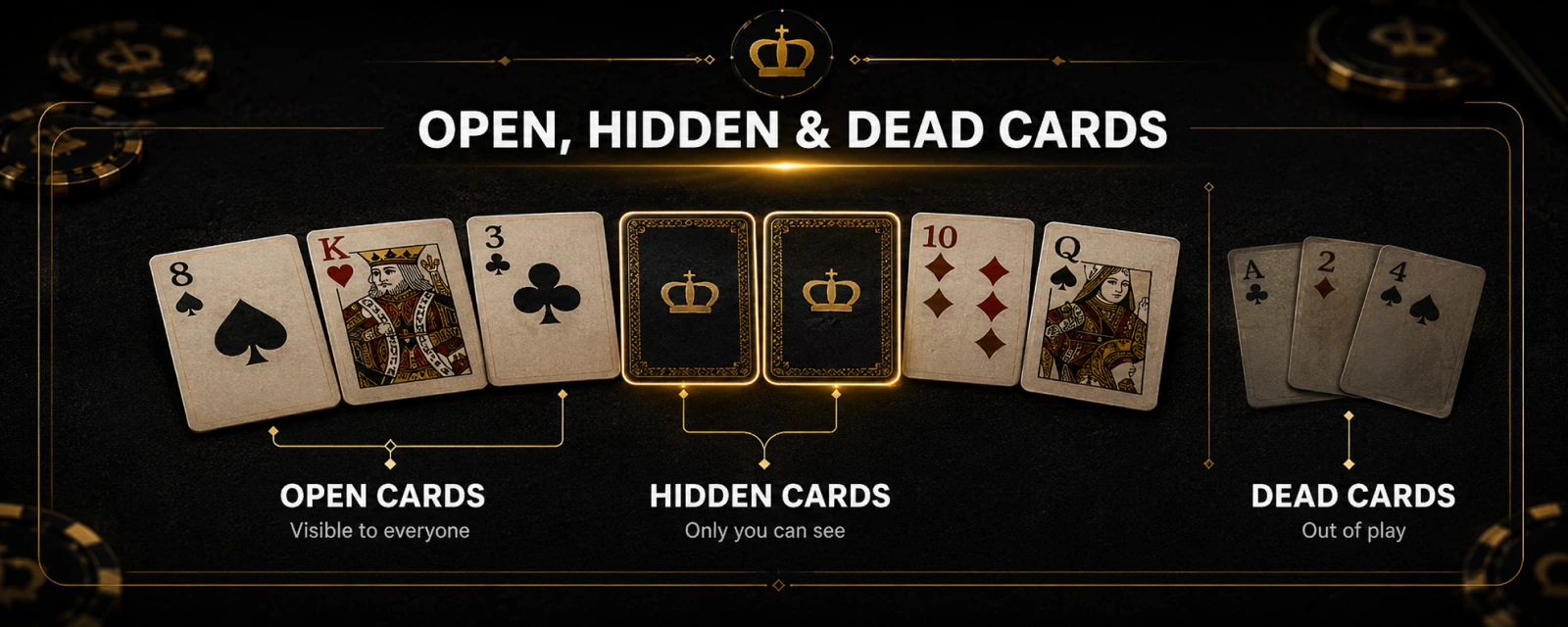
In Seven-Card Stud, understanding the difference between open cards, hidden cards, and dead cards is an important part of the game. Unlike community-card poker games, many of the cards in play are visible to everyone at the table. This creates a unique dynamic in which players can gather information not only from their own hand but also from the cards their opponents reveal during the hand.
By paying attention to these different types of cards, players can make more informed decisions about betting, calling, or folding. Observing which cards are already visible also helps players estimate the chances of completing certain hands, such as straights or flushes.
- Open Cards (Upcards): These are cards dealt face up. Everyone at the table can see them, which provides valuable information about possible hand strengths.
- Hidden Cards (Hole Cards): These cards are dealt face down and are only visible to the player who receives them. Hidden cards add an element of uncertainty because opponents cannot see their exact value.
- Dead Cards: In Seven-Card Stud, dead cards are cards that are known to be unavailable because they have already been exposed and folded, or are otherwise out of play. Tracking these cards helps players judge how likely they are to complete hands such as straights, flushes, or pairs.
Position and Betting Order In 7 Card Stud
In Seven-Card Stud, position works differently than in community-card games like Texas Hold’em. Since betting order is determined by exposed cards rather than button position, the first player to act can change depending on the stage of the hand and the visible cards on the table. These rules are tied to each player’s exposed cards.
Because several cards are dealt face up during the hand, the player showing the strongest or weakest hand at certain stages will control the action. If two players show the same best visible hand, the tie is usually broken by position, with the player who received cards first acting first. This system keeps the game dynamic and requires players to constantly pay attention to the table.
Here’s how betting order works in Seven-Card Stud:
- Third Street (First Betting Round): The player with the lowest face-up card must make the bring-in bet. If two players show the same low card, the tie is broken by suit: clubs, diamonds, hearts, then spades.
- Fourth Street: The player showing the strongest visible hand begins the betting.
- Fifth Street: The player with the best hand again acts first, and the betting limits usually increase at this stage.
- Sixth Street: The player with the strongest exposed cards continues to act first.
- Seventh Street: The final betting round also starts with the player showing the best visible hand among the remaining players.
7 Card Stud Poker Hands
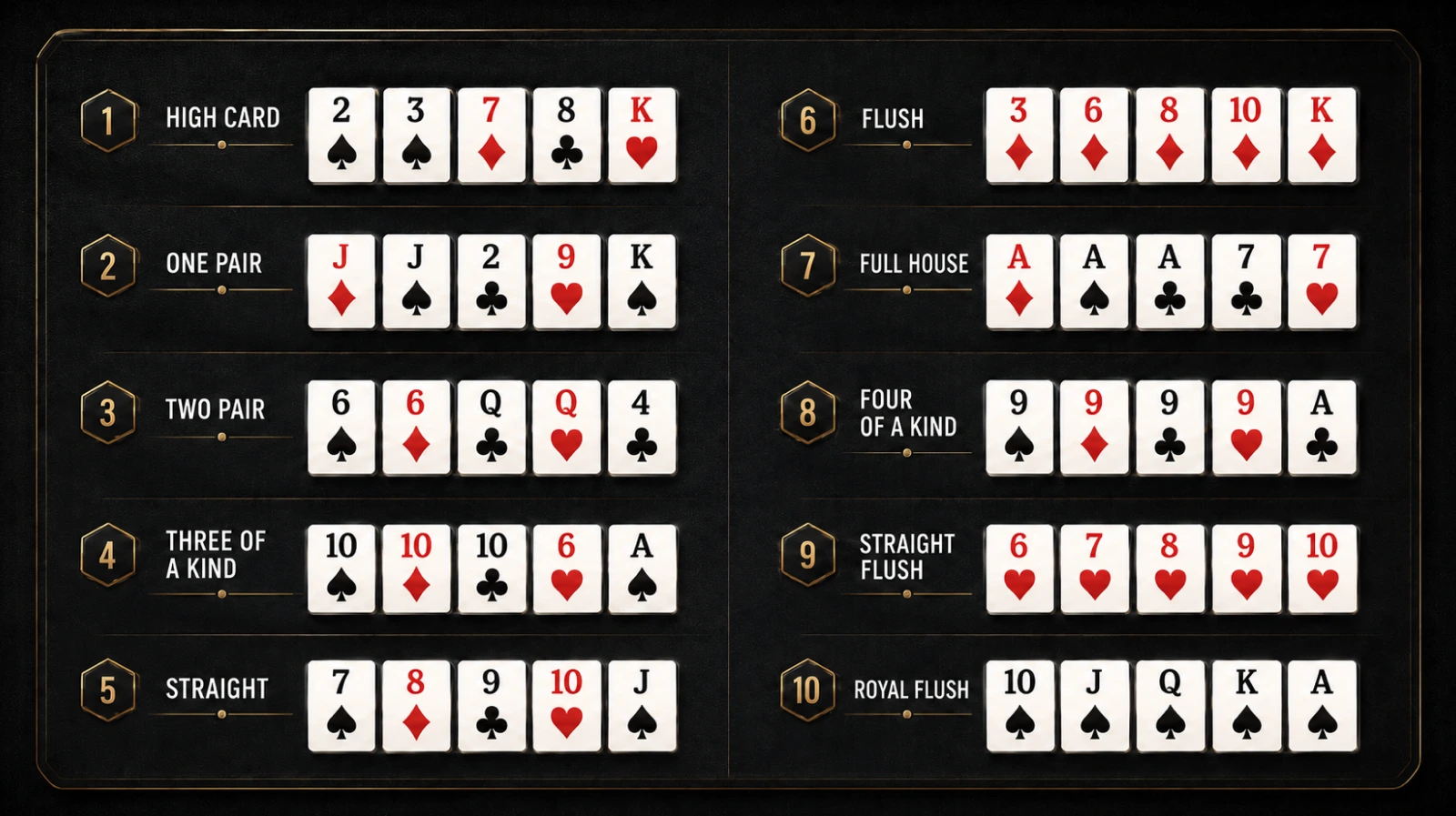
In Seven-Card Stud, players receive seven cards during the hand but only use the best five cards to form their final poker hand. The stud hand rankings follow the standard poker hierarchy used in most poker games. Building the strongest five-card combination from your seven cards is the ultimate goal, and players must evaluate their options carefully as each new card is dealt. Standard 7 Card Stud Poker Hand Rankings (from highest to lowest):
- Royal Flush – A, K, Q, J, 10 all in the same suit.
- Straight Flush – Five consecutive cards of the same suit.
- Four of a Kind – Four cards of the same rank.
- Full House – Three of a kind plus a pair.
- Flush – Five cards of the same suit.
- Straight – Five consecutive cards of mixed suits.
- Three of a Kind – Three cards of the same rank.
- Two Pair – Two different pairs.
- One Pair – Two cards of the same rank.
- High Card – The highest card when no other hand is made.
Choosing the best 5-card hand from 7 cards
At the end of a Seven-Card Stud hand, each player has seven cards in total, three face down and four face up. However, only the best five-card combination counts when determining the winner. Players must evaluate all possible five-card combinations from their seven cards to identify the strongest hand according to standard poker rankings.
For example, a player holding seven cards might be able to form both a flush and a straight, but only the higher-ranked hand will matter at showdown. In many cases, the best possible hand uses a mix of face-up and face-down cards.
7 Card Stud Betting Structure
Seven-Card Stud is traditionally played using a fixed-limit betting structure, which means the size of bets and raises is predetermined. Unlike no-limit poker games where players can bet any amount of their chips, fixed-limit games control how much can be wagered during each betting round. This structure keeps the game steady and strategic, with a stronger focus on hand reading and long-term decision-making rather than large all-in bets.
Because the betting limits are fixed, players must carefully manage their bets across several rounds while considering the visible cards on the table. The betting system in Seven-Card Stud also includes a bring-in bet, which helps start the action after the initial deal.
Fixed-limit betting rules
In most Seven-Card Stud games, betting follows a fixed-limit format where the bet size changes as the hand progresses. Early betting rounds use a smaller limit, while later rounds allow larger bets to build the pot. Key fixed-limit rules include:
- Small bets early: Third Street uses the lower betting limit. Fourth Street usually uses the lower limit too, although an open pair may allow the higher limit.
- Higher bets later: Fifth Street, Sixth Street, and Seventh Street use the higher betting limit.
- Limited raises: Most games allow a maximum of three or four raises per betting round.
- Structured betting: Players can check, bet, call, raise, or fold according to the fixed betting amounts.
- Consistent bet sizes: The bet amount cannot exceed the predetermined table limit.
Bring-in and forced bets
Seven-Card Stud uses a bring-in bet to start the first betting round. This forced bet ensures that there is immediate action in the hand after the initial cards are dealt. Key points about bring-in and forced bets:
- Antes first: All players must place a small ante before the cards are dealt.
- Lowest upcard posts the bring-in: The player with the lowest face-up card on Third Street must make the bring-in bet.
- Bring-in is smaller than the normal bet: It is typically a fraction of the lower betting limit.
- Other players respond: Players can call the bring-in, fold, or complete to the full betting amount.
- Action continues in a clockwise direction: After the bring-in, betting proceeds around the table as it does in other poker cash games.
7 Card Stud vs. Texas Hold’em: Key Differences
Seven-Card Stud and Texas Hold’em are two classic poker variants, but they differ significantly in how hands are dealt, how players build their hands, and how information is shared at the table. While Texas Hold’em uses community cards that all players can access, Seven-Card Stud gives each player their own set of cards throughout the hand.
Another major difference is the betting structure and pace of the game. Seven-Card Stud is typically played with fixed-limit betting and requires players to pay close attention to exposed cards. Understanding these differences helps players adjust their strategies depending on which poker variant they are playing.
| Feature | 7 Card Stud | Texas Hold’em |
|---|---|---|
| Community Cards | No community cards are used | Five community cards are shared by all players |
| Cards Dealt to Players | Each player receives 7 cards total | Each player receives 2 private cards |
| Visible Cards | Some cards are dealt face up | All player cards are hidden and only community cards are visible |
| Hand Formation | Best 5-card hand from the 7 personal cards | Best 5-card hand using any combination of hole and community cards |
| Betting Structure | Usually fixed-limit | Often played as no-limit |
| Starting Forced Bets | Antes and bring-in bet | Small blind and big blind |
| Information Available | Many opponent cards are visible | Opponent cards remain hidden |
How To Play 7 Card Stud Online
Playing the online version of 7-Card Stud follows the same basic rules as the traditional version played in casinos or at home. Players join a poker table, post the required ante, and are automatically dealt their cards by the platform’s digital dealer. The game then progresses through familiar stages: Third Street, Fourth Street, Fifth Street, Sixth Street, and Seventh Street, with betting rounds between each stage.
Online poker platforms clearly display the face-up cards on the table while keeping your own hole cards visible on screen. Betting actions such as checking, calling, raising, or folding are performed using simple on-screen buttons. Many online poker rooms also offer helpful features such as hand histories, timers, and pot-size information.
7 Card Stud FAQs
What is 7 Card Stud poker?
Seven-Card Stud is a traditional poker game where players receive seven cards throughout a hand and must create the best possible five-card poker combination. Unlike Texas Hold’em, there are no community cards. Some cards are dealt face up, making observation and strategy important elements of the game.
How many cards do you get in 7 Card Stud?
In Seven-Card Stud, each player receives a total of seven cards during the hand. Three cards are dealt face down and four cards are dealt face up. From these seven cards, players must choose the best possible five-card poker hand to compete at the showdown.
Why are dead cards important in 7 Card Stud?
Dead cards are cards that are no longer in the game. Tracking them helps players judge whether important outs are still live when drawing to a flush, straight, or pair.
What is a bring-in in 7 Card Stud?
The bring-in is a forced bet that starts the first betting round in Seven-Card Stud. After the initial deal, the player with the lowest face-up card must place the bring-in bet. This ensures action begins and gives other players the option to call, raise, or fold.
Is 7 Card Stud harder than Texas Hold’em?
Many players consider Seven-Card Stud more challenging than Texas Hold’em because it requires strong observation and memory skills. Players must track visible cards and dead cards while managing several betting rounds. However, once the basic rules are understood, the game becomes easier to follow.
Can I play 7 Card Stud safely online?
Yes, you can play Seven-Card Stud safely online if you choose licensed and reputable poker platforms. Trusted sites use secure payment systems, fair gaming software, and player protection measures. Always check licensing, security features, and user reviews before registering on any online poker site.
Thanks for your feedback!