

 Telegram
How to Play Strip Poker – Rules
Learning strip poker rules transforms a regular gathering into an exciting party event. This guide explains how to organize a session, outlining strip poker rules clearly for beginners. Players will discover the simplest way to play, understand decision rounds, and learn hand rankings. Understanding how to play strip poker requires learning standard card mechanics mixed with social forfeits.
What Is Strip Poker?
Strip poker is a popular party game that adapts traditional card games for social environments. Players substitute financial wagers with clothing forfeits and usually use standard rules from variants like Texas Hold’em or Five-Card Draw. The core difference is that when a player loses a hand, they must remove an item of clothing instead of losing money. The primary objective involves keeping your attire while forcing an opponent to get naked through superior gameplay.
The game became popular in the early 1900s as a social activity among consenting adults. Modern sessions function as icebreakers or intimate games for couples. The risk shifts from losing financial capital to physical exposure, altering how poker players approach a bet. Playing poker this way requires mutual trust and established boundaries.
How To Play Strip Poker Step By Step

Organizing a successful game of poker that involves stripping starts with gathering supplies and setting strict boundaries.
Setting The Rules And Dealing The Cards
The host needs a standard 52-card deck and a private room. Players who want to play strip poker must agree on the final limits before dealing cards. Groups decide whether the game ends at underwear or continues until participants get naked. Equalizing the starting inventory is critical for fairness. Every person must start with an identical number of items.
A player wearing winter gear has a mathematical advantage over someone in summer attire. Minor items like a single sock, a wristband, or jewelry help balance the counts. Groups of four to six people typically use seven to eight items per one player. The dealer shuffles the deck and distributes cards based on the chosen variant.
Betting and Decision Rounds
The betting structure depends on the chosen game mechanics. A chipless format bypasses traditional betting rounds entirely. Players receive cards, make any allowed decisions for the chosen variant, and proceed straight to the showdown. This simpler method provides a fast way to play for casual participants.
Groups that use poker chips get a more strategic game. Players start with equal chip stacks and conduct standard betting rounds. A player only removes a garment when they completely exhaust their chip stack and must buy back into the game. Folding presents a mechanical issue in chip-less formats. If folding carries no penalty, participants will fold until they receive unbeatable cards. Many groups implement an ante system requiring every player to risk one piece of clothing before cards are dealt.
Showdown And Strip Rules
The showdown occurs when remaining players reveal their cards to determine the winner. The evaluation normally follows standard hand rankings. The stripping mechanics used at this stage dictate the pace of the session.
The quick version applies the same penalty to all losing players. The player holding the strongest hand wins and remains clothed. Every other participant involved in the showdown must remove one piece of clothing. This method significantly speeds up the undressing process.
The slower, more common version implements a targeted penalty system. The player with the worst card combination is identified as the single loser. The loser removes one item of clothing, while all others keep theirs.
Strip Poker Hands
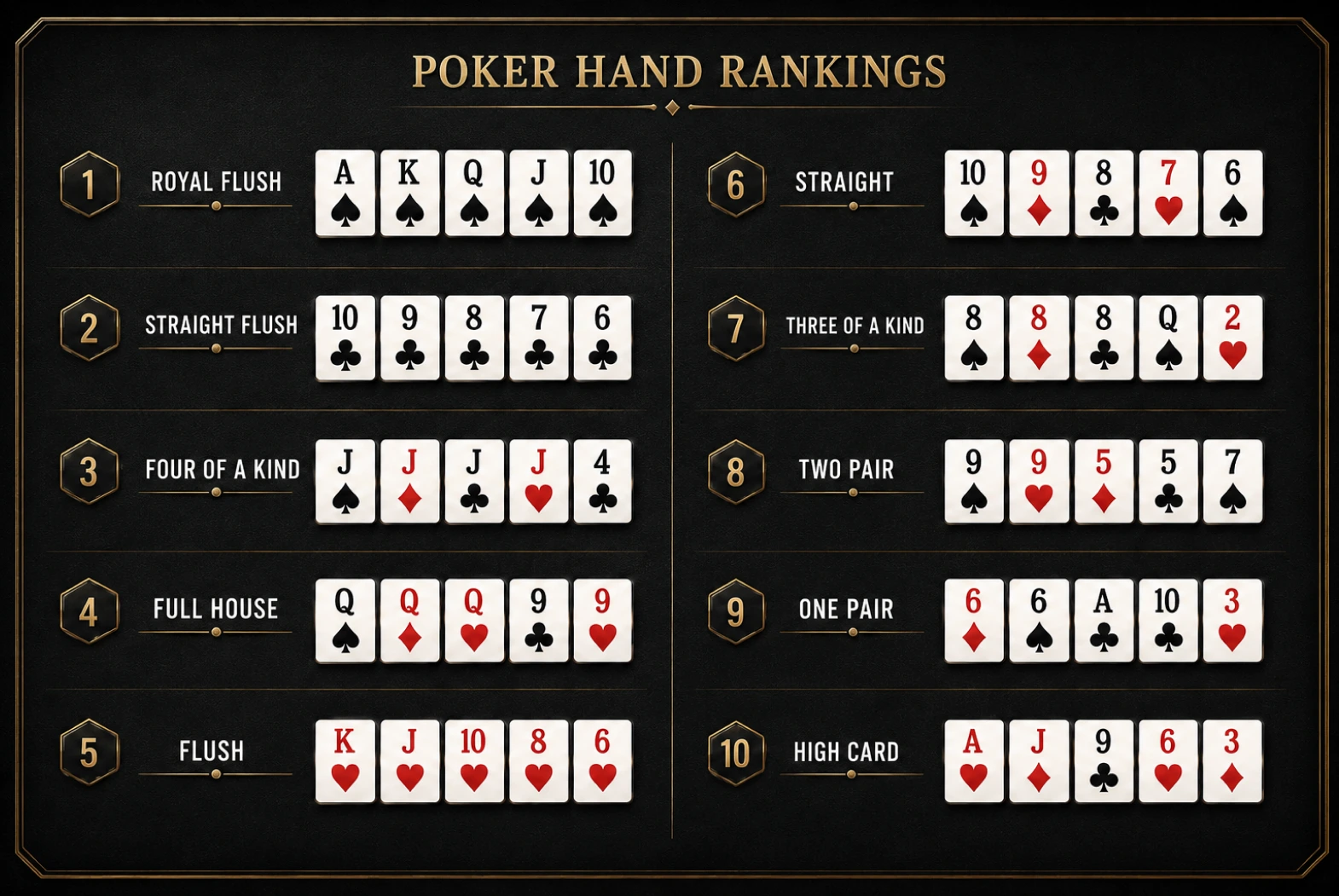
Evaluating a poker hand relies on a standardized hierarchical system. Poker hand rankings are based on the best five-card hand a player can make. Suits hold no relative value against one another. Understanding these rankings is paramount, as miscalculating hand strength directly leads to forfeiting garments. The mathematical probability determines the hierarchy, with the rarest combinations holding the highest value.
- Royal Flush: The highest combination features the Ace, King, Queen, Jack, and Ten of the exact same suit.
- Straight Flush: Five sequential cards belonging to the identical suit.
- Four-of-a-Kind: Four cards of the same numerical rank or face value.
- Full House: Three cards of one rank paired with two cards of another rank.
- Flush: Any five cards belonging to the same suit, without any sequential order.
- Straight: Five cards in sequential numerical order featuring a mixture of suits.
- Three-of-a-Kind: Three cards of the same rank accompanied by two unrelated cards (kickers).
- Two Pair: Two distinct sets of paired ranks, plus one final unrelated card.
- One Pair: A single set of two cards sharing the same rank.
- High Card: A hand with no matching ranks, no five-card sequence, and not all five cards of the same suit; it is ranked by its highest card.
Strip Poker Betting Rules
Integrating betting mechanics requires careful adjustment for social settings. Clothing functions as a set of indivisible, highly valuable units. The rules governing how these units are risked dictate the entire strategic landscape. Players must explicitly agree on the exchange rate if chips are introduced.
- The Rebuy System: Players receive an initial allotment of poker chips. Upon facing elimination due to a zero balance, the player removes one garment to receive a fresh chip stack.
- The Showdown Tax: To discourage excessive folding, any player reaching the final showdown with the losing hand must remove a garment.
- The Clothing Ante: Every player places a minor item into the center before cards are dealt. The winner takes the pot, and the losers permanently forfeit the items they wagered.
- Graduated Value Exchange: Different garments are assigned specific chip values. Removing a jacket might yield 50 chips, while a shirt yields 200 chips.
- No Buy-Back Protocol: Once an article of clothing is removed, it cannot be won back or worn again for the remainder of the session.
Strip Poker Rule Variations
Strip poker does not follow one universal format. Most groups keep the same basic idea: the cards decide the outcome, and clothing replaces money as the penalty. Beyond that, the structure can vary quite a lot depending on the mood of the group and the type of session people want. Some versions use chips or points to slow the pace and add more strategy. Others connect each lost hand directly to a clothing penalty. Some simplify the poker side even further to create a quicker, more casual game. The most common formats are outlined below.
Strip Poker With Chips Or Points
Incorporating chips or a numerical point system transforms the event into a strategic game. This format mirrors traditional cash games, allowing participants to use advanced tactics similar to standard poker. A secondary currency insulates players from immediate physical exposure. A skilled player experiencing bad luck loses plastic chips rather than their clothes.
- Chip Buffers: Players begin with equal chips, utilizing clothing strictly as a rebuy mechanism when bankruptcy occurs.
- The Slow Burn: Chips artificially extend the timeline, allowing participants to socialize for hours before significant undressing occurs.
- Tactical Rebuys: Players must decide when it is worth sacrificing a minor garment to receive a fresh chip stack and stay in the game.
- Action Incentives: House rules frequently impose a clothing penalty on the player with the worst hand at showdown.
Strip Poker With Item-Based Penalties
The item-based penalty method removes abstract currencies entirely. Each round functions as a self-contained unit of risk where the outcome directly dictates the removal of clothing. This removes the bet-sizing complexity that comes with chip-based play. The simplicity of this model makes it a popular choice for casual social gatherings. To ensure fairness, participants usually agree on a baseline number of items of clothing to wear beforehand.
- Truth or Dare Hybrids: A player facing a penalty may opt to answer a truth or dare question instead of removing a garment.
- Pass Limits: House rules impose a set limit on how many times a player may choose the truth or dare option to prevent stalling.
- The Winner’s Prerogative: The individual holding the winning hand is granted exclusive authority to select which losing player must remove one item.
- Elimination Alternatives: Players who have reached their pre-agreed boundary limit act as dealers for the remainder of the session.
Strip Poker With Fixed Strip Rules
Fixed rules strip the game down to its most basic mechanical components. These variations cater to couples seeking rapid progression without working through more complex poker decisions. The defining characteristic is the immediate resolution of each round.
- High Card Draw: Every participant receives a single card, and the player with the lowest card suffers the penalty immediately.
- Couples’ Duel: A highly intimate variation designed exclusively for two partners, utilizing simplified rules to foster a romantic atmosphere.
- Task Integration: The winner of the draw assigns a romantic task alongside the mandatory clothing removal.
- Fixed Quotas: Both participants agree to wear identical numbers of items, guaranteeing a synchronized escalation of the session.
Strip Poker Vs Texas Hold’em: Key Differences
Traditional Texas Hold’em and strip-poker formats operate on divergent economic principles. Hold’em functions as a game of capital accumulation, where the explicit objective is to bankrupt opponents. The strategic framework relies on calculated aggression and complex bet sizing.
The strip type of poker subverts this paradigm by replacing financial stakes with personal vulnerability. The objective shifts from wealth accumulation to personal preservation. Bluffing is often less frequent in strip poker, because the consequences of losing can feel more immediate and personal.
| Feature | Standard Texas Hold’em | Strip Poker Variation |
|---|---|---|
| Primary Currency | Financial capital, cash, or tournament chips | Articles of clothing and wearable accessories |
| Core Objective | Amass the entire chip pool available on the table | Retain personal attire while opponents remove theirs |
| Penalty for Losing | Loss of committed financial wagers within the pot | Mandatory removal of a designated garment |
| Rebuy Mechanism | Purchasing additional chips with financial capital | Sacrificing an article of clothing for a chip stack |
| Impact of Folding | Preserves the remaining chip stack without penalty | Often penalized to prevent passive stalling |
How To Play Strip Poker Online
Online strip poker is a very niche format rather than a mainstream poker category. In most cases, players either use a single-player format built around standard poker hands and visual progression, or join a private online session where the poker software handles the cards while the strip element remains a separate agreement between the participants.
The functional side is usually simple. A platform may offer character selection, play-money chips, basic poker rounds, chat, avatars, and sometimes more reactive dialogue or AI-assisted presentation.
What matters most for the reader is that online strip poker rarely works like a large, active multiplayer poker room with a built-in strip mode. More often, it is a lightweight single-player experience or a private social setup with limited functionality, a small player base, and rules that are handled outside the software itself.
Strip Poker FAQs
What Is Strip Poker?
It is a casual adaptation of a traditional poker game where the standard currency is replaced by the garments worn by the players. Participants utilize standard rules, but the individual holding the losing hand is penalized by removing an article of clothing.
Is Strip Poker Legal In The US?
Yes, private strip poker between consenting adults is generally treated as legal in the US, because it usually does not involve a cash prize or something of clear monetary value. However, legality still depends on state law and the setting. If the game takes place in public, in a commercial venue, or where non-consenting people can see it, it may trigger public indecency or similar laws.
Can I Play Strip Poker Safely Online?
No, not fully. Because the strip poker game involves nudity or exposure, you cannot guarantee privacy once content is shared online. Even in private sessions, there is always a risk of recording or misuse. The only truly safe option is avoiding online strip poker altogether.
Does Strip Poker Follow Standard Poker Rules?
The core mechanics still follow standard poker rules, regardless of which poker variant the group chooses. Players utilize the standardized hierarchy of hand rankings to determine the outcome of a round. The foundational rules regarding card dealing and betting order follow the specific variant chosen by the group for their poker game.
What Happens When A Player Loses A Hand In Strip Poker?
That depends on the rules agreed before the session begins. In many versions, the losing player removes one item of clothing. In other formats, every player who loses at showdown removes one item, or players only strip after running out of chips in a rebuy-based game. The poker side still follows normal hand rankings, but the clothing penalty depends on the house rules the group chooses.
Is Strip Poker The Same Game As Texas Hold’em?
They are not the same thing: Texas Hold’em is a specific poker variant, while strip poker is a social penalty format that can be applied to different poker variants.
Thanks for your feedback!