

 Telegram
How to Play Omaha Poker – Rules
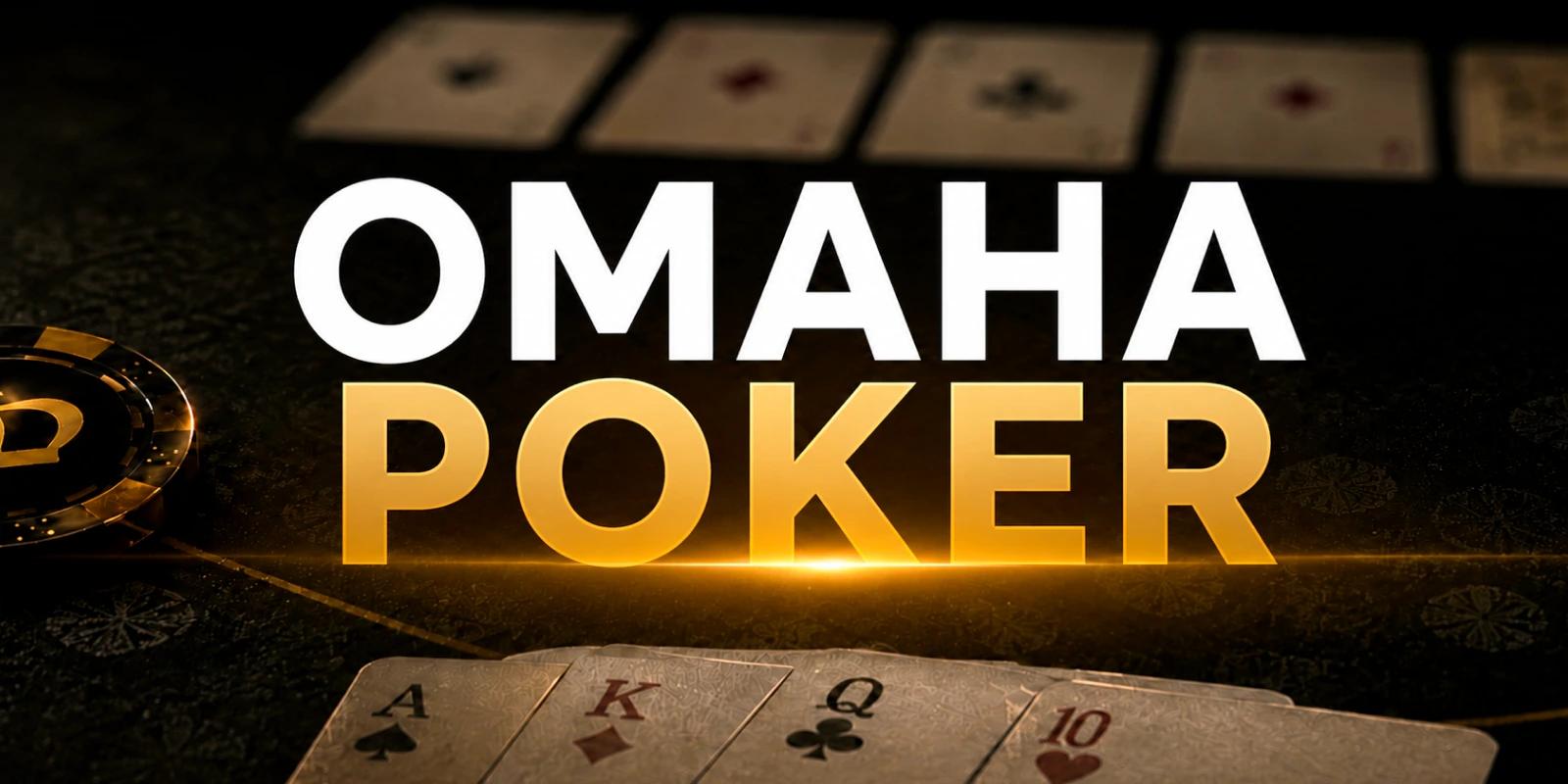
If you’re new to Omaha poker, this guide will help you learn how to play Omaha from scratch. We’ll cover the basics of Omaha poker, including hand rankings, betting rules, and how it differs from Texas Hold’em. The key feature of Omaha is that each player gets four hole cards, but you must use exactly two of them along with three community cards to form your final hand. This guide will ensure you know how to play Omaha correctly and avoid common beginner mistakes.
What Is Omaha Poker?
Omaha poker is a community card poker game and one of the most exciting poker variants. In this card game, each player is dealt four hole cards, while five community cards are placed face-up on the table. The objective of Omaha poker is to create the best five-card hand using exactly two of your hole cards and three of the community cards.
This rule, which requires using two hole cards and three board cards, is what sets the Omaha game apart from Texas Hold’em, where players can use any combination of their cards. Often referred to as Omaha, this poker variant challenges players to think strategically and adapt to the unique hand-building mechanics. Mastering the basics of Omaha will help you enjoy this thrilling game of Omaha and avoid common beginner mistakes.
How To Play Omaha Poker
To learn how to play Omaha poker, it is important to understand the structure of the game. Omaha poker follows the same basic structure as other community-card poker games, with a few key differences. Each hand begins with blinds and the deal of four hole cards to each player. From there, the game progresses through several betting rounds, including the preflop, flop, turn, and river, before reaching the showdown.
If you want to know how to play Omaha correctly, you need to learn the rules for each stage of the game. This step-by-step breakdown will guide you through the process and help you master the flow of Omaha poker.
Blinds and deal hole cards
In Pot-Limit and No-Limit Omaha, the game begins with two forced bets: the small blind and the big blind. These blinds ensure there is money in the pot before any cards are dealt. The action preflop starts with the player left of the big blind.
Once the blinds are posted, each player is dealt four hole cards in Omaha, which are private and only visible to the player. The cards are dealt one at a time to each player. A strong starting hand in Omaha is crucial, as the four hole cards in Omaha provide more possibilities than in other poker variants.
Preflop betting round
After the four hole cards are dealt, the first betting round begins. Omaha players, starting with the position left of the big blind, decide whether to continue the hand. Just like in other popular poker games, the basic actions are check, bet, call, raise, or fold. However, in the preflop round, with the big blind in play, poker players typically choose between folding, calling, or raising.
For those who play poker or are familiar with how to play Texas Hold’em, the preflop betting round in Omaha will feel similar. This stage sets the tone for the hand, as Omaha players evaluate their starting cards and decide their next move.
The flop and betting round
After the preflop betting round, the dealer places the first three community cards face-up on the table. This stage is called the flop and introduces new possibilities for building a hand in Omaha. A new betting round begins, starting with the first active player to the left of the button.
At this point, it is crucial to remember that Omaha players must use two of their four hole cards and three community cards to make the best possible hand. Unlike other poker variants, you cannot use just one hole card or all the community cards. This rule ensures that every possible hand in Omaha is built consistently, making strategic decisions even more important.
The turn and betting round
Once the flop betting round is complete, the dealer places the fourth community card on the table. This stage is called the turn and provides Omaha players with even more information to evaluate their hands in Omaha poker.
A new betting round begins, following the same order, starting with the first active player to the left of the button. At this point, players can better assess the strength of their Omaha poker hand and the potential for high hand combinations. The turn often plays a critical role in shaping the final outcome, as it can complete draws or significantly improve a player’s position in the game.
The river and final betting round
The river is the fifth and final community card dealt face-up on the table. With all five community cards now revealed, players have all the information they need to form their best five-card poker hand.
A final betting round takes place, starting with the first active player to the left of the button. At this stage, players must decide whether to continue to the showdown or fold their hand. Since no more cards will be dealt, the focus shifts to creating the best poker hand possible using two hole cards and three community cards. The river often determines the winner, as players aim to build the best five-card poker hand.
Showdown
At the showdown, the player with the best hand wins the pot. In Omaha, this hand must be made using exactly two hole cards and three community cards. Unlike other poker variants, players cannot “play the board” or use just one hole card with four community cards.
Each player reveals their cards, and the dealer evaluates the hands to determine the winner. The player with the best five-card poker hand wins, so it is crucial to carefully select the two hole cards that will make the best five-card combination. This strict rule of hand construction is what sets Omaha apart and ensures a fair and strategic game.
Omaha Poker Hands
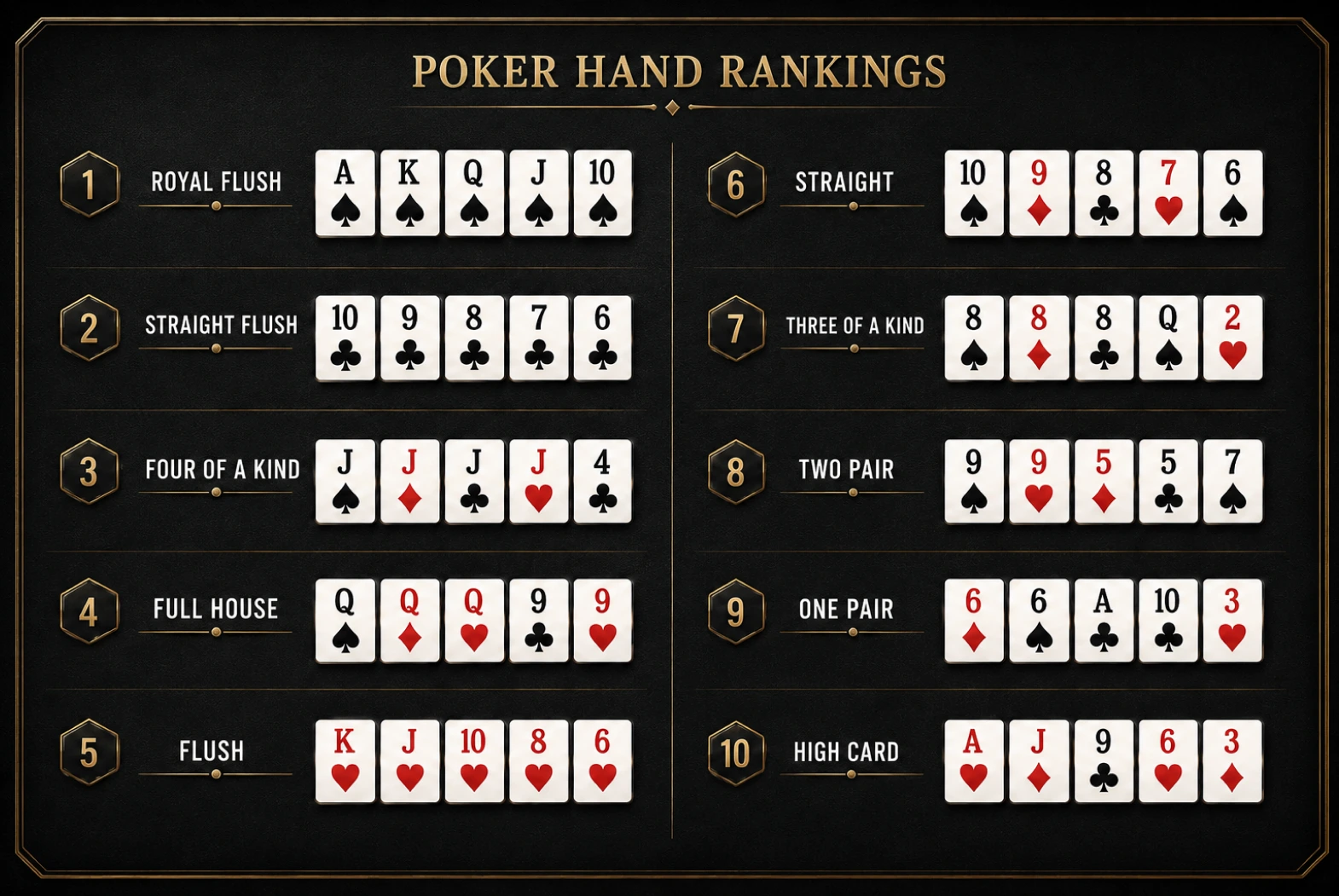
In Omaha High, the poker hand ranking system follows the traditional hierarchy used in Texas Hold’em, ranging from a high card to a royal flush. However, it is important to remember that hands in Omaha poker must always be formed using exactly two hole cards and three community cards. This rule can make even familiar poker hand rankings feel different for new players.
Here is the standard ranking of Omaha poker hands, from highest to lowest:
- Royal Flush – A, K, Q, J, 10 of the same suit.
- Straight Flush – Five consecutive cards of the same suit.
- Four of a Kind – Four cards of the same rank.
- Full House – Three of a kind plus a pair.
- Flush – Five cards of the same suit.
- Straight – Five consecutive cards of any suit.
- Three of a Kind – Three cards of the same rank.
- Two Pair – Two different pairs.
- One Pair – Two cards of the same rank.
- High Card – The highest single card when no other hand is made.
Mastering these rankings will help you identify the best poker hand and improve your Omaha poker strategy.
Omaha Poker Betting Rules
The rules of Omaha poker follow standard betting mechanics, making it easy for poker players familiar with other games to adapt. Betting rounds occur in four stages: preflop, flop, turn, and river. Players can check if no bet has been made, or they must call, raise, or fold if a bet is already on the table. Omaha can be played as a limit game, pot-limit, or no-limit, with pot-limit being the most common format.
Here are the key rules of Omaha betting:
- Check – If no bet has been made, you can pass the action to the next player.
- Call – Match the current bet to stay in the hand.
- Bet – If no bet has been made, you can make the first wager in the round.
- Raise – Increase the current bet amount.
- Fold – Discard your hand and exit the round.
- Betting Rounds – Occur in four stages: preflop, flop, turn, and river.
Understanding these rules of Omaha ensures smooth gameplay and helps poker players make strategic decisions during each betting round.
Betting Formats In Omaha Poker
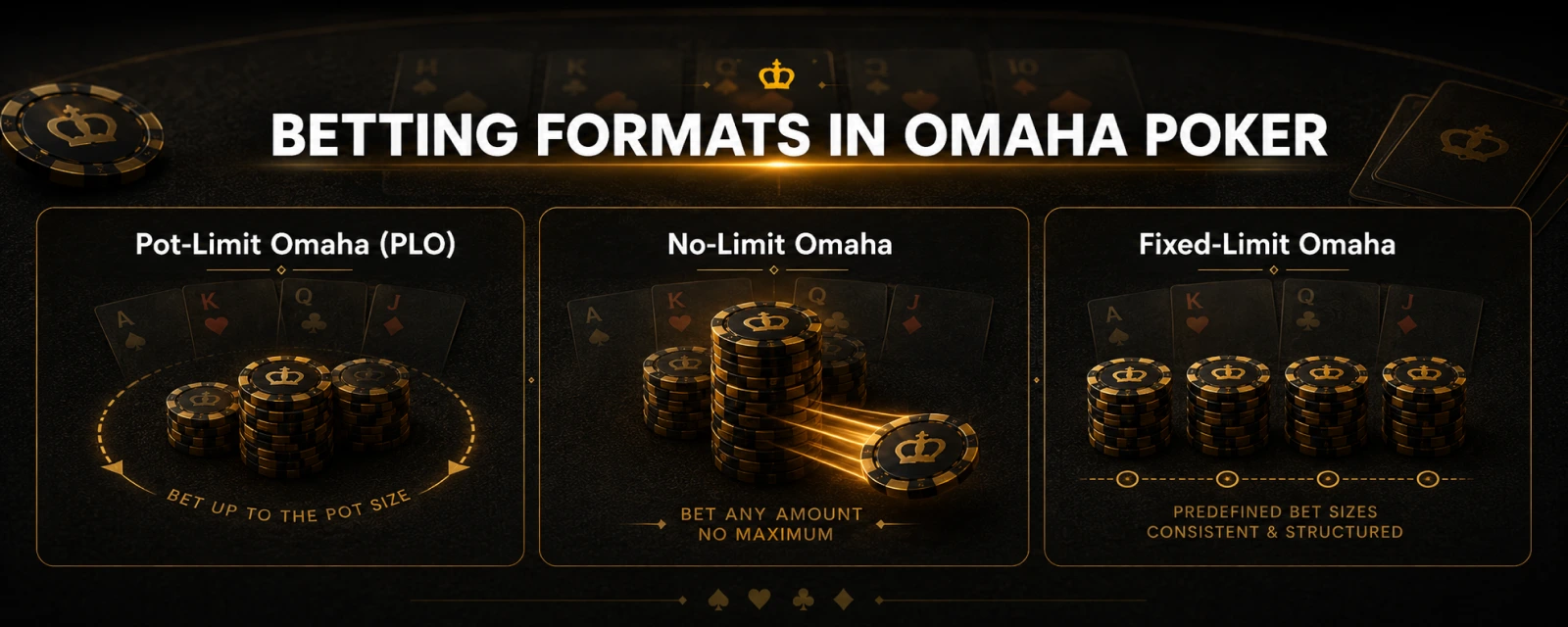
There are several ways to play Omaha poker, each offering unique dynamics and strategies. The most popular Omaha variant is Pot-Limit Omaha (PLO), but players can also explore No-Limit and Fixed Limit Omaha formats.
Each format has its own betting structure, from the controlled stakes of fixed limit Omaha to the more flexible and aggressive styles of pot-limit and no-limit games. Understanding these formats is key to choosing the right way to enjoy Omaha poker.
Pot-limit Omaha (PLO)
Pot Limit Omaha (PLO) is the most common and popular version of Omaha poker. In this format, the maximum bet or raise is limited to the size of the current pot. This makes the rules of Omaha poker slightly more complex than in Texas Hold’em, especially when calculating pot-sized bets.
For example, if the pot is $100 and no action has occurred before you, you can bet up to $100. If there’s already a bet, the maximum pot-sized raise includes the call amount plus the pot.
Here are the key rules for betting in PLO:
- Pot-Sized Bets – The maximum bet or raise equals the current pot size.
- Raise Calculation – Includes the pot, your call, and the opponent’s bet.
Understanding these rules helps players navigate the unique dynamics of Pot Limit Omaha.
No-limit Omaha
No-Limit Omaha is a less common but exciting poker format. In this version, the minimum bet is typically equal to the big blind, while the maximum bet can go up to a player’s entire stack (all-in). This creates high-stakes opportunities and dramatic moments, especially in online poker and live poker rooms.
Here are the key rules for No-Limit Omaha:
- Minimum Bet – Equal to the size of the big blind.
- Maximum Bet – No limit; players can go all-in at any time.
- Minimum Raise – Must be at least the size of the previous bet or raise in the same round.
While not as widely played as Pot-Limit Omaha, No-Limit Omaha offers thrilling gameplay for those seeking more aggressive poker action.
Fixed-limit Omaha
Fixed-Limit Omaha is a structured Omaha variant where bet sizes are predetermined, making it a more controlled limit game compared to Pot-Limit or No-Limit Omaha. In this format, preflop and flop betting rounds use a lower betting unit, while turn and river rounds follow a larger betting unit. Additionally, the number of raises per betting round is typically capped, often allowing a bet, raise, re-raise, and a final cap.
Here are the key rules for Fixed-Limit Omaha:
- Structured Bets – Preflop and flop use smaller bets; turn and river use larger bets.
- Raise Cap – Limited to a set number of raises per round.
- Controlled Gameplay – Bet sizes are fixed, reducing variance and aggressive play.
This Omaha variant is ideal for players who prefer a more strategic and less volatile poker experience.
Omaha Vs Texas Hold’em: Key Differences
The difference between Omaha and Texas Hold’em lies in the number of hole cards, hand construction rules, and the strength of typical winning hands. While both games share similar betting rounds and community card structures, the differences between Omaha poker and Texas Hold’em significantly impact strategy and gameplay.
| Aspect | Omaha Poker | Texas Hold’em |
|---|---|---|
| Hole Cards | 4 cards per player | 2 cards per player |
| Hand Construction | Must use exactly 2 hole cards and 3 community cards | Can use any combination of hole and board cards |
The differences between Omaha and Texas Hold’em make Omaha poker more dynamic, with higher chances of strong hands at showdown, offering a unique challenge for players transitioning from Hold’em.
From personal experience, when I first switched from Texas Hold’em to Omaha, the rule of using exactly 2 hole cards and 3 community cards was the hardest to adjust to. I often misread my hand strength, thinking I had a flush or straight when I didn’t. However, with practice and focusing on starting hands, I quickly adapted and found Omaha to be an exciting and strategic game!
How To Play Omaha Poker Online
To play Omaha poker online, start by selecting your preferred format, betting limit, and table on trusted online poker sites or poker rooms. The rules of the game remain the same as in live Omaha, making it easy to transition to online play.
For beginners, it’s recommended to start with play-money tables or low-stakes Omaha poker games online to build confidence and experience. When choosing a platform, ensure it is licensed, regulated, and offers secure payments, clear rules, and responsible gaming tools.
If you prefer a more casual setting, you can also play Omaha poker at home with friends using online platforms that support private games. Whether you’re a novice or a seasoned player, online poker offers a convenient way to enjoy Omaha anytime.
From personal experience, registering on a trusted poker site is straightforward. After choosing a platform, I created an account by filling in basic details, verified my email, and set up secure payment options. Starting with play-money tables helped me get comfortable with the interface and rules before moving to real stakes.
Omaha FAQs
What is Omaha poker?
Omaha poker is a popular poker variant where players receive 4 hole cards and must use exactly 2 of them with 3 community cards to form the best five-card hand.
Can I play Omaha poker safely online?
Yes, you can play Omaha poker safely online by choosing trusted, licensed, and regulated online poker sites with secure payments and responsible gaming tools.
How do I build a winning strategy for Omaha?
Focus on starting hands with strong potential, understand the importance of position, and always consider the pot odds and possible opponent hands.
How does pot-limit betting work in Omaha?
In pot-limit Omaha, the maximum bet or raise is limited to the current size of the pot, including your call and any previous bets.
What starting hands should I avoid in Omaha?
Avoid hands with low connectivity, weak pairs, or cards that don’t work well together, such as uncoordinated suits or ranks.
Is Omaha poker the same game as Texas Hold’em?
No, Omaha poker and Texas Hold’em differ in the number of hole cards (4 in Omaha, 2 in Hold’em) and hand construction rules.
Thanks for your feedback!