


 Telegram
How to Play 5 Card Stud Poker – Rules

Five Card Stud is a classic poker variant that is easy to follow once you know the basic setup. Instead of community cards, each player builds a hand from personal cards, with most of them exposed during play. In this guide, you’ll learn how the deal works, how antes and the bring-in start the action, how betting rounds unfold, and how to recognize the winning hand at showdown.
- What Is 5 Card Stud Poker?
- How To Play 5 Card Stud
- Face-Up and Face-Down Cards In 5 Card Stud
- Betting Order and Visible Hands In 5 Card Stud
- 5 Card Stud Poker Hands
- 5 Card Stud Betting Rules
- Bring-in and forced bets
- 5 Card Stud Vs 7 Card Stud: Key Differences
- How To Play 5 Card Stud Online
- 5 Card Stud FAQs
What Is 5 Card Stud Poker?
Five-Card Stud is one of the oldest forms of poker, and a simpler relative of later stud variants. In this 5-card format, each player receives five personal cards over several betting rounds instead of sharing community cards like in Texas Hold’em.
Stud is a game of observation because most of the cards are exposed as the hand develops. That makes it a straightforward game for beginners who want to learn betting order, exposed cards, and hand reading without the extra layers of modern flop-based poker. Even so, smart timing and close attention still matter in every hand.
How To Play 5 Card Stud

A hand of 5 Card Stud follows a clear sequence, which makes the format easy to learn. First, players post antes and receive their starting cards. Then more exposed cards are added with a betting round after each deal. Once the last card is out, the remaining players go to showdown and compare hands. Below is a step-by-step look at each stage of the hand.
Antes and initial deal (one down, one up)
Each hand starts with all players posting an ante. The dealer then uses a standard deck and begins from the top of the deck, moving around the table, so each player is dealt one card face down. That hidden card is the hole card.
After that, everyone receives a second card dealt face up. This exposed card that players see first is called the door card. Once both cards are out, the player with the lowest upcard must make the bring-in. In most games, the lowest visible rank opens the action, although house rules may use suits to break a tie. From there, the first betting round begins.
Betting rounds as face-up cards are dealt
After the bring-in and opening action, the remaining players continue through each street as more exposed cards are added. The third card is dealt face up to every active player, followed by another round of betting. On later streets, each next card is also dealt face up, and action begins with the strongest visible holding.
Play then moves clockwise to the next player. Depending on the situation, a player may check when allowed, take the option to bet, call, raise, or fold. Because most information is visible, every decision should account for what an opponent appears to be building. This pattern continues until all face-up cards for the hand have been delivered.
Final card and showdown
Once the fifth and final card is dealt, and the last betting round is complete, the remaining players go to showdown. At that point, the players show their cards by turning over the hidden card that has not yet been seen. The goal is to make the best hand using all five cards dealt in the hand.
The player with the strongest combination will win the pot. If two players have identical holdings, the result is a tie and the pot is split according to the house rules. In many hands, the final betting action determines whether the hand goes to showdown or whether all other players fold.
Face-Up and Face-Down Cards In 5 Card Stud
One of the main features of 5 Card Stud is how much information is visible during the hand. Unlike community-card games, players do not share a board, but they can still learn a lot from exposed cards. Only the first card is hidden, while the rest are dealt openly as the hand develops.
Once a card is dealt face up, it remains visible on the table for everyone to track. That makes it easier to follow possible draws, compare visible strength, and estimate what other players may be holding. In classic 5 Card Stud, the card pattern works like this:
- First card: face down.
- Second card: face up.
- Third card: face up.
- Fourth card: face up.
- Fifth card: face up.
So, by showdown, each player has one hidden card and four exposed cards.
Betting Order and Visible Hands In 5 Card Stud
In 5 Card Stud, betting order does not stay fixed from start to finish. After the opening action, later rounds are based on exposed cards, so visible strength matters at every stage. The best hand showing determines who acts first, which means position can change as new cards appear.
That rule makes the game more strategic because players must watch every exposed card, not just their own. On later rounds, the player with the best hand showing starts the action, while every other player still in the hand follows in order. If the visible strength changes, the betting lead can change too. In practical terms, the highest visible holding controls the action after the opening round.
- The opening round starts differently from later betting rounds.
- Visible cards help determine who acts first.
- The best hand showing leads the action.
- Only active players are counted in betting order.
- Action can shift as exposed hands improve.
5 Card Stud Poker Hands
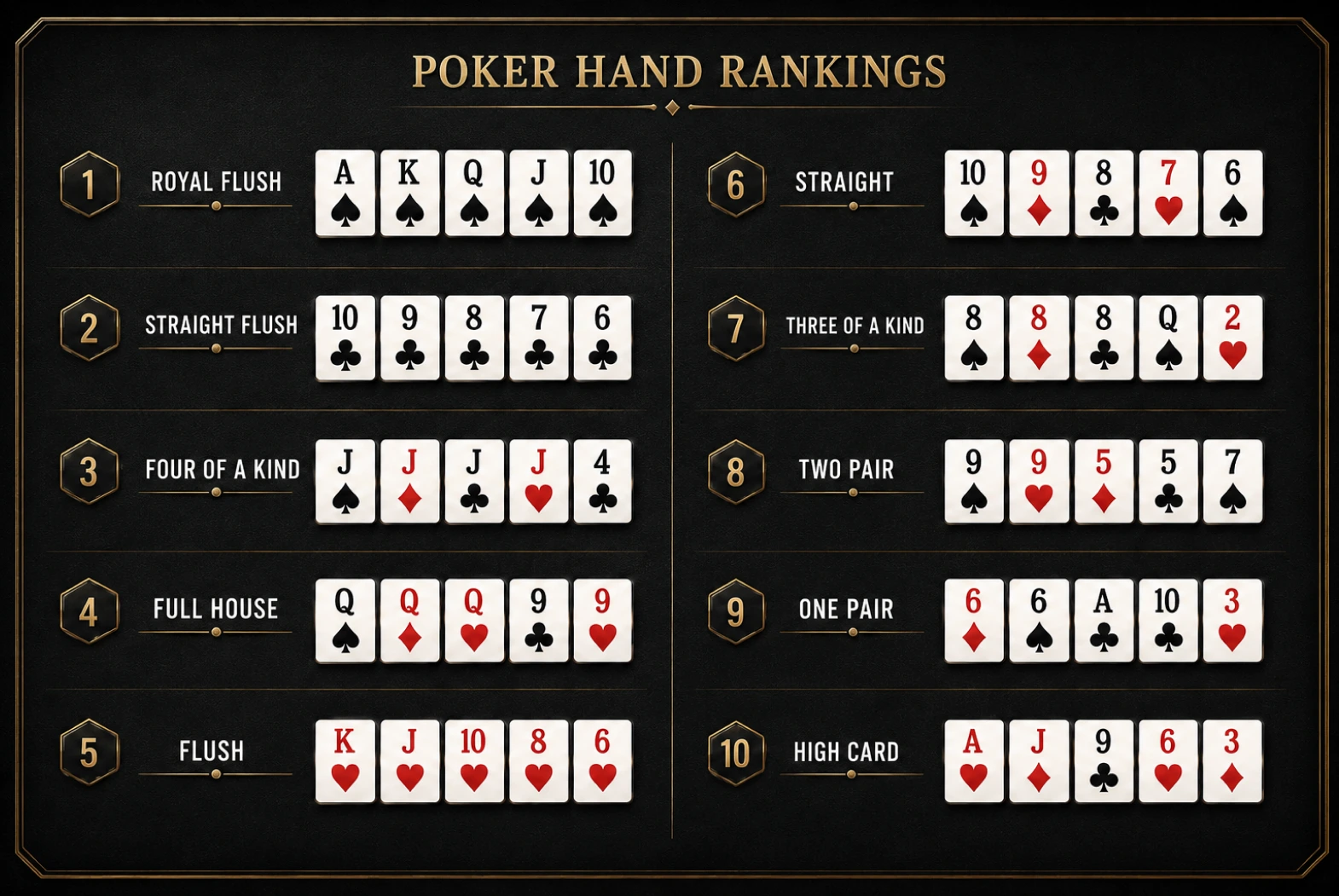
In 5 Card Stud, hand rankings follow the standard poker order used in most high-hand games. The goal is to make the strongest five-card combination from the five cards a player receives. That means a pair, straight, flush, or full house works the same way it does in other poker formats.
A hand can also be affected by rank and suit. For example, a pair is made from two cards of the same rank, while a flush is made from five cards of the same suit, whether that suit is a club, spade, heart, or diamond. An ace can be part of the highest straight or, in some cases, the lowest straight.
Standard 5 Card Stud hand rankings, from highest to lowest, are:
- Royal Flush.
- Straight Flush.
- Four of a Kind.
- Full House.
- Flush.
- Straight.
- Three of a Kind.
- Two Pair.
- One Pair.
- High Card.
5 Card Stud Betting Rules
Betting rules in this game are usually simple and structured. Instead of blinds, players begin with antes, and the action is opened by a bring-in after the first upcard is dealt. Most games use a fixed-limit format, so bet sizes are set in advance and stay consistent through each stage of the hand.
Fixed-limit betting structure
In a fixed-limit game, players do not choose any bet size they want. The structure sets exact amounts for each round, which keeps the action orderly and makes decisions easier to follow. Early betting rounds are usually played at the lower limit, while later rounds move to the higher limit.
That change matters because exposed hands usually become stronger as more cards are dealt. In many fixed-limit 5 Card Stud games, the higher betting limit begins on fourth street and continues through the final betting rounds. However, if a player shows an open pair on third street, some games allow the higher limit to be used on that round instead. This structure gives the game a steady pace and makes it easier to track risk from round to round.
- Bet sizes are predetermined.
- Early action usually uses the lower limit.
- Later action usually uses the higher limit.
- Raises follow the fixed betting size.
- Some games allow players to bet the higher amount when an open pair appears.
Bring-in and forced bets
The bring-in is a forced opening bet used to start the first betting round. After each player receives one hidden card and one exposed card, the player showing the lowest rank must post that forced amount. This replaces the blind structure seen in flop games and gives the hand a clear starting point.
The bring-in is often smaller than the full small bet, although exact amounts depend on the game. After that forced action, other players can call, fold, or complete the bet to the full limit. Because the bring-in is tied to the lowest exposed card, it also adds strategic pressure right from the beginning of the hand.
- All players post an ante before the deal.
- The bring-in starts the first betting round.
- The lowest exposed card is required to post it.
- The forced bet is often smaller than a full opening bet.
- Other players may fold, call, or complete the wager.
5 Card Stud Vs 7 Card Stud: Key Differences
5 Card Stud and 7 Card Stud belong to the same poker family, but they play differently in practice. The biggest differences involve the number of cards dealt, how much information is exposed, and whether the final hand is made by using five fixed cards or choosing the best five-card combination.
| Feature | 5 Card Stud | 7 Card Stud |
|---|---|---|
| Total cards per player | 5 cards | 7 cards |
| Face-down cards | 1 | 3 |
| Face-up cards | 4 | 4 |
| Betting rounds | 4 | 5 |
| Final card | Usually dealt face up | Usually dealt face down |
| Showdown hand | Uses all 5 cards dealt | Uses the best 5 out of 7 cards |
| Complexity | Simpler and easier to follow | More complex and information-heavy |
| Reading opponents | Based on 4 exposed cards | Based on 4 exposed cards plus more hidden strength |
| Beginner friendliness | More beginner-friendly | Requires more hand-reading experience |
How To Play 5 Card Stud Online
Playing 5 Card Stud online is easiest when the setup is simple and the game details are clear before the first hand begins. A careful start helps new players learn the format faster and avoid mistakes with limits, antes, and betting order.
Start by picking a trusted poker platform or online card room that offers stud games in your region.
Make sure the table is 5 Card Stud, since many sites mainly feature other variants.
Look at the ante, bring-in, and limit structure before joining.
Begin with smaller games to get comfortable with the pace and exposed cards.
Pay attention to visible hands and betting order on every round.
After gaining confidence, consider a tournament if that format is available.
5 Card Stud FAQs
What is 5 Card Stud poker?
5 Card Stud is a classic poker variant in which each player receives five personal cards over several betting rounds. There are no community cards, and most of the hand is exposed, so reading visible strength is an important part of play.
How many cards do players get in 5 Card Stud?
Each player gets five cards total in a standard hand of 5 Card Stud. In the classic format, one card is dealt face down and the other four are dealt face up as the hand moves through its betting rounds.
How does betting order work in 5 Card Stud?
The first betting round starts with the bring-in after the opening deal. On later rounds, action begins with the player showing the strongest exposed hand, so betting order can change as new upcards are dealt.
What is a bring-in in 5 Card Stud?
A bring-in is a forced opening bet used to start the first betting round in 5 Card Stud. It is usually posted by the player showing the lowest upcard after the initial deal, before regular action continues.
Is 5 Card Stud suitable for beginners?
Yes, 5 Card Stud is often suitable for beginners because the structure is easy to follow, and the hand develops in a clear order. It also helps new players practice betting rules, exposed-card reading, and basic hand strength evaluation.