


 Telegram
How to Play Texas Hold’em Poker – Rules

Texas Hold’em is the world’s most recognized poker game, known for simple mechanics, steady pace, and plenty of decision-making from hand to hand. New players often see it at casino tables, in home games, and across online poker platforms, but the basics are easier to grasp than they may seem at first.
This guide is built for beginners who want a clear, practical introduction. It explains how to play Texas Hold’em in a way that is easy to follow, while also breaking down the core Texas Hold’em rules that shape each hand. Readers will learn how a Hold’em game works from start to finish and gain the knowledge needed to join a table with confidence.
Texas Hold’em Poker – Essential Terms
Before learning the full sequence of a hand, players should know the table language used throughout the game. These terms explain positions, cards, shared board action, and the moments when decisions matter most:
- The button marks the dealer position.
- The small blind and big blind are forced bets posted before the deal.
- Hole cards are each player’s two private cards.
- Community cards are shared by everyone still in the hand.
- The flop is the first three board cards, followed by the turn and the river.
- The pot contains the chips wagered during the current hand.
- Fold means leaving the hand.
- Showdown is when remaining players reveal their cards and compare Texas Hold’em hands.
Basic Rules of Texas Hold’em Poker
The core Texas Hold’em rules are simple enough for beginners to learn quickly. In each hand, every player receives two private cards, then five community cards are dealt face-up on the board in stages. The goal is to make the best possible five-card hand using any combination of private and shared cards.
Key rules to know:
- Each player starts with two hole cards.
- Five community cards are dealt during the hand.
- Players can use both, one, or none of their private cards.
- The aim is to make the best possible five-card hand.
- The player with the best hand at the showdown wins.
How to Play Texas Hold’em Poker
Understanding the order of play is the easiest way to learn how to play Texas Hold’em. Most hands follow the same structure from the dealer button and blinds through the betting rounds, and they end either when all but one player folds or when the remaining players reach showdown.
Once players know when cards appear and when decisions are made, the game becomes much easier to read at the table. The hand moves through these stages:
- The button indicates the dealer position for the current hand.
- In a standard multi-player Hold’em game, the two players to the left of the dealer button post the small blind and big blind.
- Preflop betting round begins after players receive their hole cards.
- The flop adds the first shared cards to the board.
- The turn brings one more community card.
- The river reveals the last board card.
- If two or more players are still in the hand after the final betting round, showdown decides which hand wins the pot.
The sections below explain each part in more detail, so beginners can see how the action builds from the opening deal to the final result.
The button
The button shows which player is in the dealer position for the current hand. During the game, it moves one seat clockwise after each new hand.
Its job is to mark a reference point for the table. That position helps determine how the hand is organized and where the action moves around the table. Because the Button keeps moving, every player gets the dealer position in turn. This keeps the game fair and ensures each player has an equal chance to occupy that position over time.
In simple terms, the Button does not change the cards a player receives. It changes the player’s place in the order of play for that hand.
The blinds
The blinds are forced bets placed before a hand begins. They make sure there is money in the pot from the start, so every hand has something to play for.
There are two blinds in a standard Hold’em game. The small blind is the smaller forced bet, and the big blind is the larger one. These positions move around the table from one hand to the next, so all players share them over time.
The role of the blinds is to keep the game moving and create action from the start. Without them, players could keep waiting for strong cards with no cost, which would slow the game down.
Preflop: first betting round
Preflop is the stage that sets the tone for the rest of the hand. It is the first moment when players must judge their starting cards and decide how much value they have before the board begins to build. Strong choices here can shape the action all the way to the showdown.
At this stage:
- Each player has two hole cards.
- No community cards are on the board yet.
- Action starts with the player to the left of the big blind.
- A player can fold, call, or raise. If no one has raised, the big blind may also check when the action returns.
- The betting round ends when all remaining players have matched the highest bet or no more action is needed.
The flop: second betting round
The flop is the point in the hand when the first three community cards are dealt face-up on the board. These cards are shared by every player still in the hand, so they can change the strength of many hands at once. A strong starting hand can improve, while a weak one can suddenly become much more useful.
The role of the flop is to give players their first full view of the board and to create new decisions based on the shared cards. After the Flop appears, the second betting round begins. Players now judge how well their hole cards work with the board and decide if they want to continue, bet, or protect their hand.
The turn: third betting round
The turn is the fourth shared card placed on the board. It appears after the Flop and gives players one more card to work with when building their hand. By this point, the picture is clearer, and players have a much better idea of their chances.
The role of the turn is to narrow the possibilities before the final card is dealt. It can strengthen an existing hand, create a strong draw, or change the value of the board for everyone still in the hand. Once the Turn is dealt face-up, the third betting round begins, and players decide if they want to keep going based on the new card and the action at the table.
The river: final betting round
The river is the fifth and final community card dealt on the board. It appears after the Turn and completes the full set of shared cards used to build a hand. Once the River is revealed, players know all the cards that can be used to make their final combination.
The role of the river is to bring the hand to its last decision point before showdown. It can complete a draw, improve a strong hand, or leave the board unchanged. After this card is dealt face-up, the final round of betting begins. Players still in the hand must decide if they want to check, bet, call, raise, or fold based on the finished board and the betting action.
The showdown
The showdown is the final stage of the hand. It happens when two or more players are still in the hand after the river and the final betting round. Its role is to decide the result by comparing hands and naming the winner. No more cards are dealt and no more betting takes place, so the outcome depends only on the cards each player can use with the board.
At showdown:
- Players still in the hand reveal their cards.
- Each player tries to make the best five-card poker hand.
- A player may use both, one, or none of the hole cards.
- The player with the best poker hand wins the pot.
- If two hands are equal, the pot is split.
Texas Hold’em Poker Hand Rankings
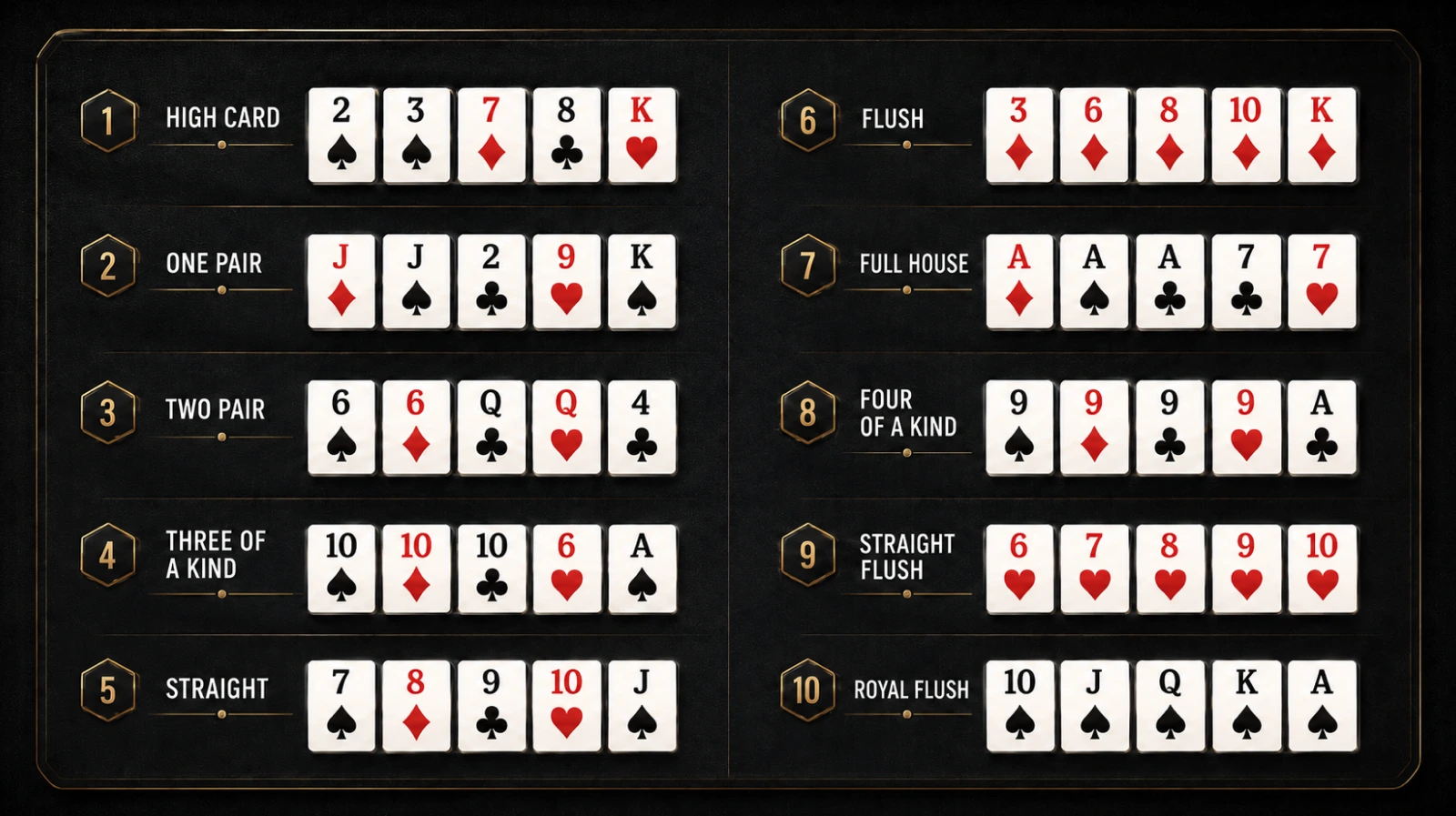
Hand rankings decide which player wins when two or more players reach showdown. In this part of the game, players compare Texas Hold’em hands by using the best possible five-card hand they can make from their two Hole Cards and the five Community Cards. The list below shows the order from strongest to weakest and prepares readers for the example in the next section.
- Royal Flush, the top hand.
- Straight Flush, five cards in order and of the same suit.
- Four of a Kind, four cards of the same rank.
- Full House, Three of a Kind plus a Pair.
- Flush, five cards of the same suit.
- Straight, five cards in sequence.
- Three of a Kind, three cards of the same rank.
- Two Pair, two different Pairs.
- One Pair, two cards of the same rank.
- High Card, when no other hand is made.
Showdown example
Here is a simple showdown example:
- The five Community Cards dealt face-up on the Board are A♠, K♠, 10♠, 10♦, and 4♠.
- Player #1 shows Q♠ and 2♠.
- Player #2 shows 10♣ and 9♦.
- When Texas Hold’em hands are compared, Player #1 makes a flush with five cards of the same suit, while Player #2 makes three of a kind with three tens.
Even though Player #2 pairs the board strongly, the Flush ranks higher than Three of a Kind. The winner is the player with the best possible five-card hand, so Player #1 wins the pot.
Additional Texas Hold’em Rules
A few extra points help complete the Texas Hold’em rules and make the game easier to follow at the table. These details may look small, but they decide who stays in a hand, who reaches showdown, and how the pot is awarded at the end.
- If a player folds, that player is out of the hand and cannot win the pot.
- If all other players fold, the last player still in the hand wins the pot without a showdown.
- If two or more players have the same hand, the pot is split equally.
- In standard Hold’em rules, suits do not break ties between equal hands.
Texas Hold’em FAQs
What do I need to know about Texas Hold’em poker?
To understand how to play Texas Hold’em, learn the hand order, basic poker rules, table position, and hand rankings. It also helps to know when to bet, fold, call, or raise.
How can I win at Texas Hold’em?
Winning comes from making better decisions than the other players. Knowing all Texas Hold’em hands, playing only with strong starting cards, and folding in weak spots at the right time improves results over many sessions.
How many betting rounds do I play in Texas Hold’em?
A standard Hold’em hand has four betting rounds: Preflop, Flop, Turn, and River. Each round ends when every active player has acted and the betting round is complete.
How many players can play Texas Hold’em at one table?
Texas Hold’em is played with 2 to 10 players at one table. Action moves clockwise around the table, but the starting player depends on the stage of the hand: preflop action begins with the player to the left of the Big Blind, while flop, turn, and river action begin with the first active player to the left of the Button.
How many cards do I get in Texas Hold’em?
Each player receives two Hole Cards. Over the hand, five Community Cards are dealt face-up on the board, and players use any combination to make the best possible five-card hand.
When should I fold my hand?
A player should fold when the hand is unlikely to improve, the board is dangerous, or the betting action shows clear strength. Good folds protect chips for better spots.
What variations of Texas Hold’em can I play?
Players can choose different Hold’em formats, including No-Limit Texas Hold’em, Pot-Limit Texas Hold’em, and Fixed-Limit Texas Hold’em. Players can also play Heads-Up Texas Hold’em, which is the two-player version of the game. The main structure stays similar, but betting limits and table format can change.
Thanks for your feedback!